

If you rely on slip resistance testing to evaluate the safety of a floor, one question matters more than any other:
Can the test be trusted to give the same answer every time?
That question—precision and repeatability—is at the heart of a new video we’ve just released.
In Courtrooms – Precision Matters!
The Problem: Inconsistent Test Results
In the United States, certain tribometers—such as the English XL and Brungraber Mark IIIB—are still used in some slip-and-fall litigation. However, these instruments have been the subject of significant criticism in the scientific literature.
A 2020 peer-reviewed study titled “Quantifying the Uncertainty in Tribometer Measurements on Walkway Surfaces” (Siegmund, Brault, et al.) documented substantial variability in measurements:
- Different operators produced different results
- Different instruments produced different results
- Even repeated tests on the same surface could vary
When a test method cannot reliably reproduce the same result under the same conditions, it raises serious concerns about its suitability for assessing real-world safety.
Why Precision Matters
Slip resistance testing is not just an academic exercise—it directly impacts:
- Public safety
- Building design decisions
- Liability determinations
If a test device produces inconsistent results, it becomes difficult—if not impossible—to draw reliable conclusions about whether a surface is safe or hazardous.
That’s why precision and reproducibility are fundamental requirements of any scientific test method.
The Pendulum Difference
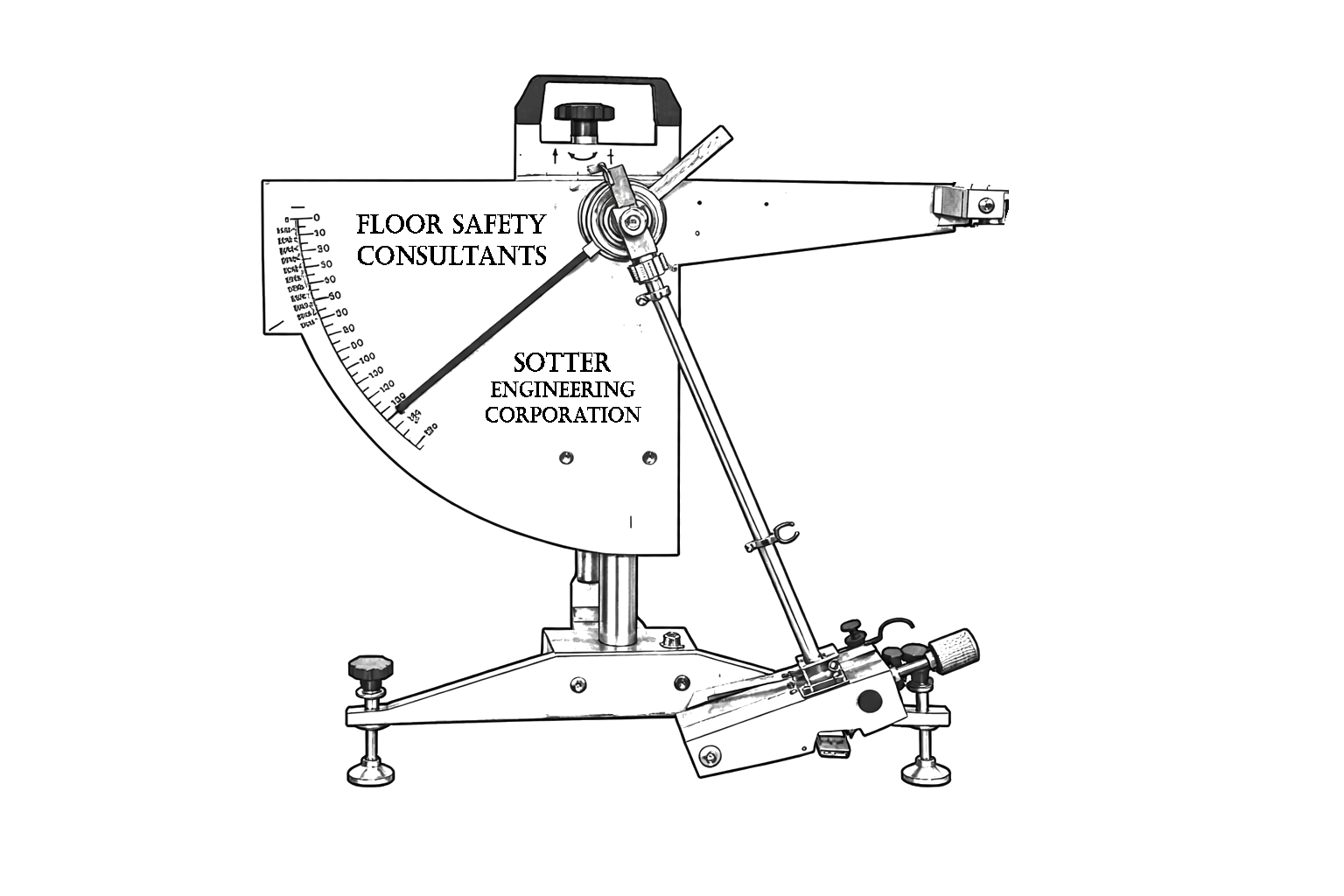
The pendulum test method (ASTM E303-22 and AFSA FS101-25) takes a different approach.
It is:
- A dynamic test that simulates the heel strike of a walking pedestrian
- Supported by decades of international research
- Used in dozens of countries worldwide
- Backed by established calibration and verification procedures
Most importantly, the pendulum has demonstrated strong interlaboratory consistency, meaning different operators and different instruments can obtain comparable results under controlled conditions.
A Global Perspective
Across much of the world—including the UK, Europe, Australia, and other regions—the pendulum test is widely accepted for evaluating slip resistance in both design and forensic contexts.
This broad international adoption reflects confidence in the method’s:
- Reliability
- Repeatability
- Relevance to real-world walking conditions
Safety Should Come First
Ultimately, the goal of slip resistance testing should be simple:
👉 Identify hazardous surfaces before injuries occur
Reliable testing methods make that possible.
Unreliable methods create uncertainty—and uncertainty does not improve safety.
Watch the Full Video
In this video, we walk through:
- Why some commonly used devices produce inconsistent results
- What the scientific literature actually says
- Why dynamic testing methods provide a more reliable assessment
In Courtrooms – Precision Matters!
Final Thought
When it comes to floor safety, the question isn’t just “What number did you get?”
It’s:
👉 “Can that number be trusted?”