

Unfortunately, because the USA is a highly litigious society with personal injury attorney billboards littering every roadway across the land, there has emerged three distinct camps of “floor slip resistance testing experts” here. The first two are filled with industry participants who make the slip and fall situation worse – getting innocent people killed and horribly injured with the unreliable floor slip resistance test methods they publish, deceive architects with, and use to win slip and fall lawsuits. The third camp is much, MUCH smaller, and is made up of independent, third-party testing labs interested in helping stop the slip and fall epidemic in the USA.
If you’d prefer to listen to a podcast talking about this blog post while you drive, click here.
The first camp is made up of “non-profits” that pretend that they are interested in helping stop slip and fall injuries from occurring, but they pander to and are supported by the flooring industry itself, and these “non-profits” help the people they represent come up with slip resistance test methods (that keep getting withdrawn, or exposed as bad tests that don’t accurately assess safety) that serve to tell us that slippery flooring isn’t slippery, and another “non-profit” sells “high traction” stickers for flooring and floor products. Both of these “non-profits” help manufacturers of flooring and floor products make more sales and profits. The test methods they publish are part of the problem because they do not accurately identify slippery floors. They used to use ASTM C1028 to fool flooring consumers, until the test was exposed as a fraudulent safety test and withdrawn by the ASTM.
Here’s a video showing Camp #1’s latest test, ANSI A326.3 with the BOT-3000E, doing a really bad job of identifying a slippery floor as slippery:
The rest of the world doesn’t fall for this American nonsense. They use independent, reliable science that’s been researched for well over 50 years to help avoid slips and falls from happening, partly because many other counties (especially in Europe) have a system of universal health care, which means even the government, as well as building owners and architects, have an interest in stopping preventable slip and fall injuries. It costs the governments of these countries money fixing broken arms and hips with tax dollars that is much better spent elsewhere, such as housing the homeless, or buying second mansions for themselves.
The second camp consists of full-time litigation experts, who work primarily work for insurance companies and personal injury attorneys. They often fall very close to being “liars for hire”, in my opinion. Their interest is not in science or stopping slips from occurring. Their interest is figuring out a way to get the result the lawyer paying them wants them to get. If they do a good job of saying exactly what that lawyer wants them to say, then that lawyer is much more likely to hire them the following week when another slip and fall lawsuit comes across their desk. By pandering to big-time lawyers that do a lot of slip and fall defense work (and pandering to the big-time personal injury attorneys at times, as well), some of these people claim to have testified in hundreds or even more than a thousand slip and fall lawsuits. These are full-time professional “experts” that make the situation worse with unproven tests that lack precision and international acceptance.
The more people that get injured in slip and fall incidents, the more jobs available to these “experts” in camp #2, so why would they be interested in stopping them from happening? They aren’t. They don’t work for architects and building owners using proven, reliable and precise scientific devices that will help these people stop slip incidents from happening, but rather they come in with data of questionable reliability after the injuries have occurred to help win, win, win these high-dollar lawsuits.
The two most common instruments used by this camp of “experts” are the English XL and the Brungraber Mark IIIB, and it’s baffling how these “instruments” that have been proven to lack precision in published studies are still let into American courtrooms as “science” since they were rejected by OSHA, the ASTM, and the international community of experts in this crucial field of study long ago. They are anything but reliable, internationally-accepted science.
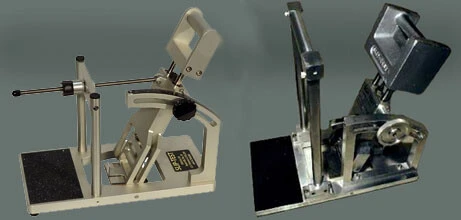
These imprecise “slip test instruments” are not intended to help stop the slip and fall injury epidemic in America, and they are rarely, if ever, used to help stop slips and falls from happening. They are primarily only used in American courtrooms to win lawsuits. Below are photos of the Brungraber Mark II and Mark IIIB used by full-time courtroom “experts”. One has a withdrawn ASTM standard (withdrawn over 20 years ago), and the other one has no peer-reviewed, published test standard in ANY nation because it lacks precision. In essence, it’s been proven that every operator of this device gets a different answer on the exact same spot of flooring. This allows users of this device to learn to keep testing with the Brungraber Mark IIIB until they get the answer the lawyer wants. I’ve often seen the users of this device demand that no-one witness their testing.
In fact, one peer-reviewed, published research study from Australia stated quite clearly that, “When compared to the other test methods, the [English XL] VIT tends to underestimate the wet slip resistance of smooth polished, glazed or surface-protected tiles, while overestimating the slip resistance of tiles with a textured or profiled surface.” This means that these devices are fantastic at saying moderately slip resistant floors are very slippery, and can also help the career litigation “expert” provide data indicating that floors that aren’t slippery are more slippery than they are. They don’t work to properly assess the slip resistance of floors, in other words. A perfect courtroom device for professional “experts” that need to provide data that may defy real-world conditions.
ASTM F2508 was created by some of these “experts” to “validate” their instruments (since valid scientific instruments will all have international acceptance and published test methods, and theirs do not). The instruments they use have recent peer-reviewed, published studies showing that they lack precision, and therefore they have no chance of publishing a test method anywhere on earth. The “science” and common sense behind this “verification procedure” ASTM F2508 for instruments that have proven to lack reliability and precision is absolutely laughable. In my opinion, the rationale behind F2508 is scientifically difficult to justify, and that is discussed in the link provided. Its approach raises serious concerns about the criteria used to evaluate reliability and precision in courtrooms.
The fact that the users of the Brungraber Mark IIIB were able to publish this through the ASTM and rely on it in court raises serious concerns about how such methods are evaluated, admitted and published.
ASTM F2508 will convince you that Camp #2 of slip resistance test “experts” are in the slip and fall game for one reason – to help win multi-million-dollar slip and fall lawsuits with questionable data. They couldn’t care less about preventing slips and falls. They’ve spent three decades now doing all they can to stop good science from helping to stop slip and fall incidents in America. I’ve witnessed some of it, and my father did before me. Our pleas to publish internationally-approved science to help stop slips fell on deaf ears in the ASTM’s F13 committee on floor slip resistance. They clearly proved to my father and I that their mission was to NOT allow science to be published in this field of study. There was too much money at stake for themselves and the entire American “slip and fall game.”
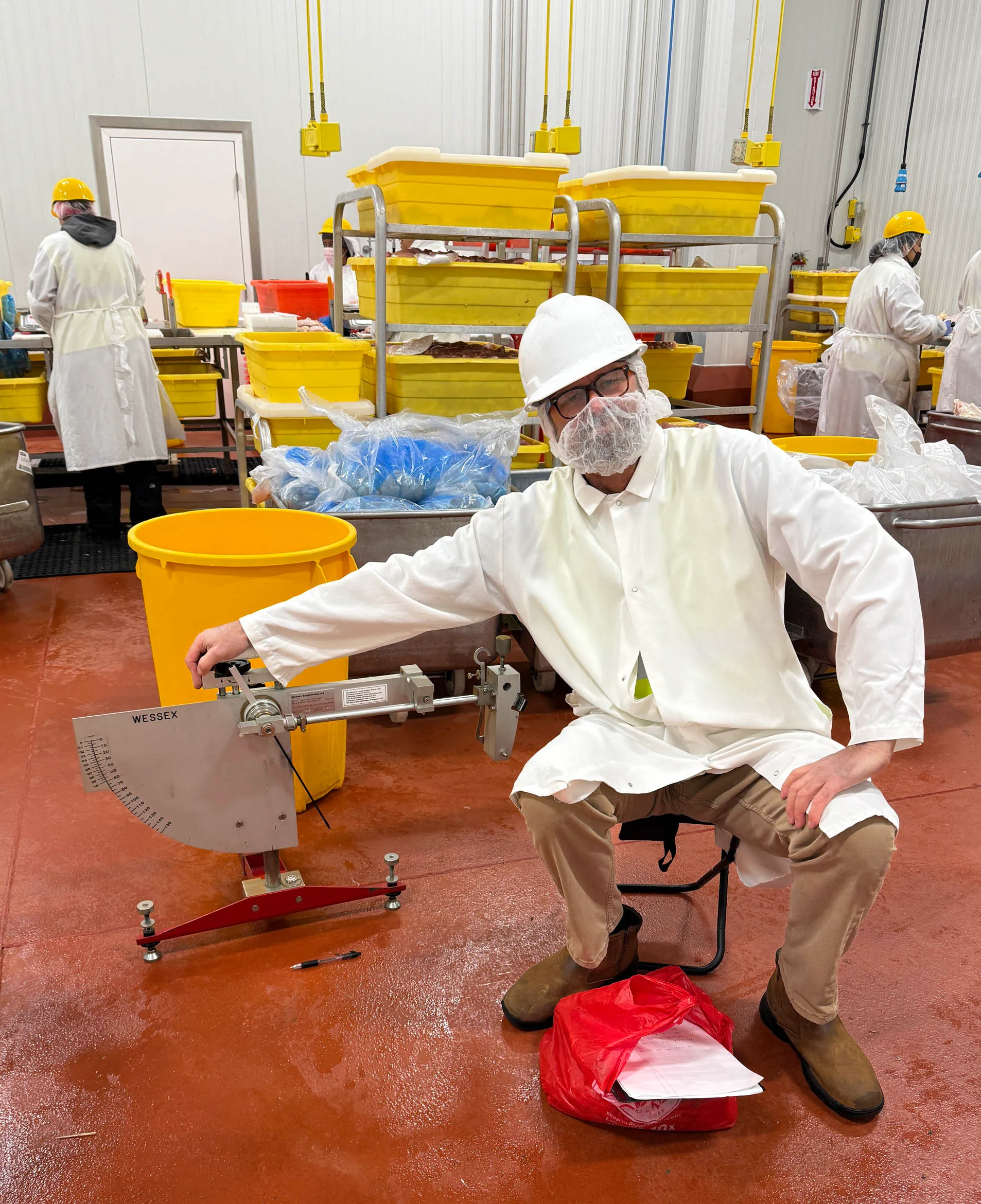
The third camp consists of independent, third-party testing labs that can help architects, flooring manufacturers, and building owners avoid slip and fall injuries from occurring. This is the only camp interested in helping stop slip and fall injuries with reliable, proven, international science created after many decades of slip and fall research around the world using the pendulum tester (shown below with me helping a meat processing plant to stop slips amongst their workers and visitors).
The first camp of “non-profits” writes and publishes slip resistance test methods designed to provide a false sense of security to architects, specifiers and building owners. They published the now-withdrawn ASTM C1028 (withdrawn in 2014), the now-expired ANSI B101.1-2009 (expired in 2014) and now-expired ANSI B101.3-2014 (expired in 2019). These were all written largely by a “non-profit” that represents the flooring industry and puts their logo on the front of their test methods now. All these test methods had to go away because too many people had been shown just how bad these tests were at identifying slippery floors. These tests suffered from stiction. These tests were telling us that the slipperiest of floors were not slippery at all. So the largest flooring “non-profit” had to publish another questionable test to help sell more slippery flooring in the USA…
Their latest is ANSI A326.3, which was also published to help flooring manufacturers fool consumers today into believing that flooring has “passed” a “slip resistance safety test,” when in fact the test method itself says on the first page of the published test method that it is not intended to be a safety test at all. So what is it for? “Comparing surfaces”, according to the first page of the test. At least they’re not lying, but they’re counting on architects and specifiers not comprehending the fact that this test definitely comes across as a “slip resistance safety test”, but the disclaimers all point to the fact that it is in NO way that. To use ANSI A326.3 as a “slip resistance safety test” is to ignore the dozens of disclaimers posted throughout the test method. It’s ignoring reality.
The ANSI A326.3 test states clearly that it, “can provide a useful comparison of surfaces, but does not predict the likelihood a person will or will not slip on a hard surface flooring material.” It also states throughout the test method that, “the measured DCOF value shall not be the only factor in determining the appropriateness of a hard surface flooring material for a particular application.” It states that several other factors must be considered (other than the DCOF value obtained), but does not offer any guidance on how to consider those “other factors”.
They leave architects and specifiers to assume that the numbers given in this test as “passing” mean that it has passed a “safety test”, when that’s not what the test says at all…and for good reason. The tile industry doesn’t want to get dragged into the thousands of slip and fall lawsuits across the country that pop up weekly. They didn’t mislead architects and specifiers into believing the floor they bought passed a “safety test”. Or did they? There was a “lunch-n-learn campaign where architects were given “ongoing education” credits, and they were told that this test is the latest and greatest “safety test”. The test itself is not at all claiming to be a safety test, but I can tell you that around 98% of “safety experts”, architects, and flooring salespeople believe that it is. They were mislead.
ANSI A326.3 (and it’s predecessor ANSI A137.1) is for “comparing surfaces”, not “assessing safety”. Many manufacturers, architects and municipal officials choose to ignore that fact, or were told to ignore that fact. Elsewhere in the ANSI A326.3 official test method, it states, “Normative measured DCOF limit values are not provided in this standard for exterior applications, interior ramps and inclines, pool decks, shower floors, or flooring that is contaminated with material other than water or where minimal or no footwear is used.” So according to that disclaimer, they’re not saying that this test is relevant to a floor with spilled coffee, tea, sunscreen, dirt or cola on it…it’s just for floors with spilled water. Don’t blame the publishers of this test if there was dried floor soap, dust, or a million other contaminants on your floor. This test doesn’t take those realities into consideration. You’re on your own in the slip and fall lawsuit. They warned you. ANSI A326.3 is in no way arguing that it’s a “floor slip resistance safety test”. I can tell you 98% of Americans in the field of flooring believe it is, for one reason or another.
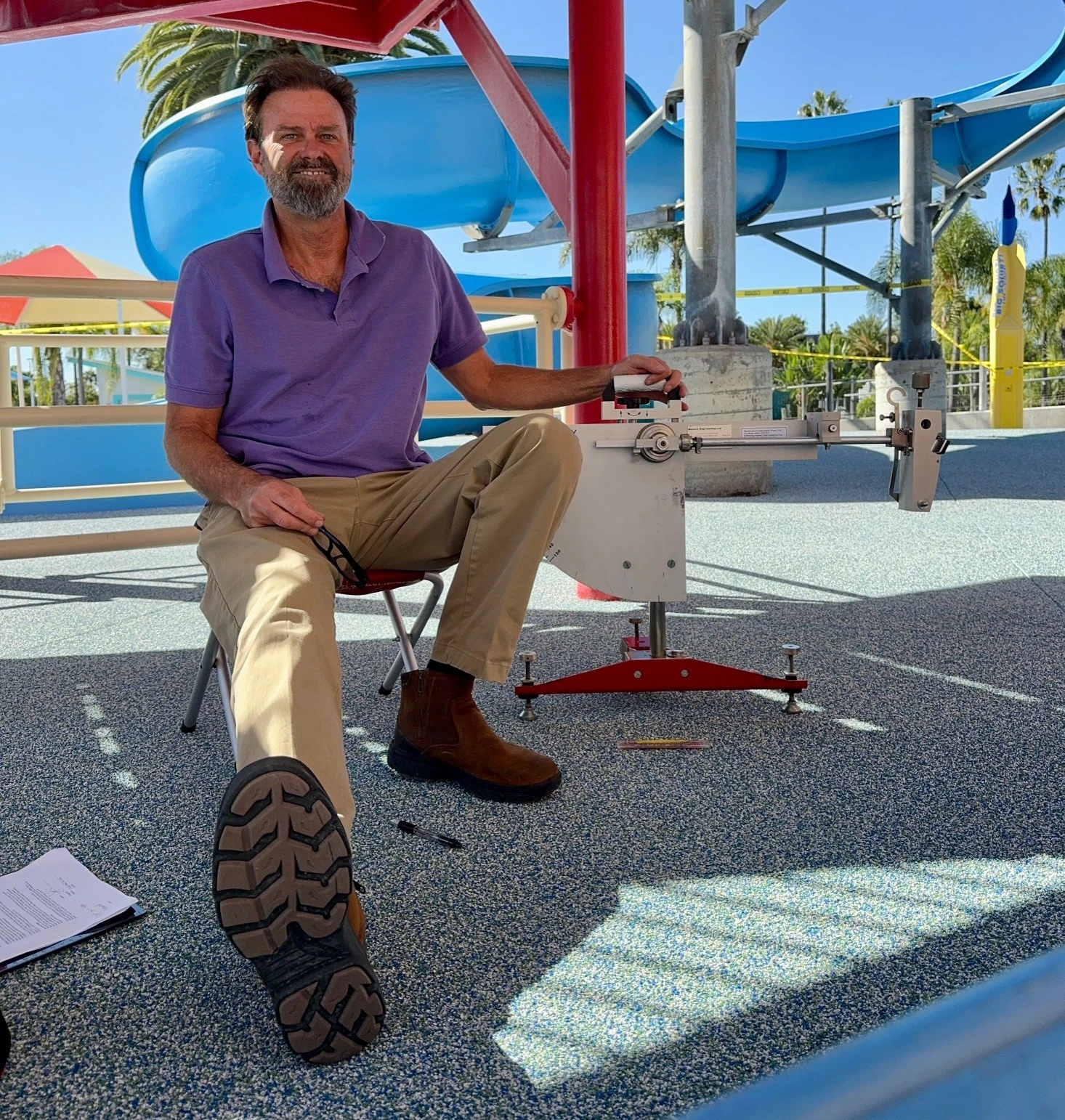
Test results from this test say far too many slippery floors aren’t slippery, and that’s one reason why they tell you on page one that the test was NOT designed to be an assessment of safety. For reliable slip resistance test safety assessments, the rest of the world has been using the pendulum dynamic coefficient of friction (DCOF) tester for decades, because it DOES assess the slip resistance safety of a floor. Below I’m testing the slip resistance safety of a “splash pad” with the pendulum tester at an amusement park.
The video below appeared on Bloomberg Businessweek several years ago, and features interviews with two of the “slip and fall game’s” biggest players in Camp #1. One of these two “experts” also makes a living in Camp #2 using test methods he publishes with his Camp #1 “non-profit”. His ability to publish test methods was taken away for a while, and then he was back for a while publishing bad test methods that are part of the problem. Then his ability to publish test methods got taken away again. It’s a “game” that gets people horribly injured and killed, in my opinion.
The amount of disinformation in this video is scary and at times just strangely bizarre, so be warned. These are mostly not facts being presented in this video…just mostly bizarre interpretations of an alternate reality, perhaps…
No-one in this video began the slip and fall prevention business, and the BOT-3000E stopped being admissible in European standards in 2008, and there doesn’t seem to be any evidence that it was ever included as part of a published European test standard (just a couple of the “bizarre” things stated in the video by these Camp #1 “experts”). The BOT-3000E certainly isn’t included in Europe’s current slip resistance test standard, EN 16165, published in 2021 for dozens of countries including the United Kingdom, who has been studying how to prevent slips and falls since around the time these two “experts” were born. Again, many of the things said in this video are far from true. The people in Camp #1 live in a different reality where stopping slips is not as important as helping to sell slippery flooring.
For historical context, Percy A. Sigler at the U.S. National Bureau of Standards developed the pendulum dynamic coefficient of friction (DCOF) test method specifically for the assessment of pedestrian traction potential, and he started publishing his results in 1943. Today that research has resulted in America’s latest reliable and proven slip resistance test method, ASTM E303-22. It’s used by Camp #3 to help stop slip and fall incidents using reliable science used on five continents. The American Floor Safety Alliance (AFSA) was later created in 2025 to publish pendulum test methods that are even closer to the European and Australian pendulum test methods, so that we in America can now utilize the 50 years of research into real-world slips in over 50 countries using a nearly identical pendulum slip test method.
Static coefficient of friction (SCOF) testing has been widely debunked by the international community. See letters published on that blog post from leading experts on three continents stating that SCOF testing was abandoned long ago by the international floor slip testing community, and why. That blog post also contains links to peer-reviewed, published studies stating why SCOF testing was abandoned around the world (except in the USA) as a valid safety assessment decades ago in Europe, the UK, Australia and elsewhere. Walk into any American coutroom today where a slip and fall case is going on, and you’ll definitely hear testimony from an “expert” who used an SCOF tester.
Here is a detailed look into why SCOF testing is no longer internationally accepted as floor safety science. Even the Tile Council of North America (TCNA), who published ANSI A326.3 (which is not a “safety test”, remember?) abandoned the SCOF test ASTM C1028 in 2014 because it was calling some of the most slippery floors on earth “not slippery” due to a problem with SCOF testing called “stiction”. SCOF testing does not work to assess safety. The world agrees on that, except for a few dozen Americans in Camp #1 and Camp #2. You will never hear SCOF numbers discussed in a court of law in a slip and fall lawsuit in Europe, The UK, Singapore, Australia, New Zealand, Israel, and many other countries. It’s mainly just used in American courtrooms. Nowhere else. That doesn’t make us greater than the rest of the world. After forty years of using both SCOF and DCOF tests, I can assure you that SCOF tests do not make America “great”.
SCOF tests measure how slippery a floor is to someone standing still (static) on the floor. People don’t slip while standing. The nonsense Camp #1 uses to convince consumers that it is relevant has been proven in published studies to be nonsense. This peer-reviewed, published study said, “This study found that the manually-pulled 50-pound drag sled (as used in ASTM C-I028) was incapable of satisfactorily distinguishing between the wet slip resistance of ceramic tiles.” This was easily the most widely-used and popular SCOF test ever in the USA until it was abandoned by the ASTM and the Tile Council of America (TCNA) in 2014. There is still one last SCOF test that still has an ASTM published test method which, in my opinion, is the most clearly misleading scam ever created in this field of study – ASTM D2047.
ASTM’s D2047 is perhaps the biggest scam safety test ever created, in my opinion, as it is measuring how slippery a clean and dry floor is to someone standing still on it. Bizarre? Yes. But it is a published ASTM test that has never been withdrawn in 75 years. It’s the only ASTM test ever published that says, basically, “anything above an SCOF of 0.50 is safe, and anything below 0.50 is not safe.” That was apparently from some long-lost research done over 75 years ago that the world of experts outside the USA ignored. UL 410 is the exact same test, using the James Machine. These tests are assessing how slippery a clean and dry floor is to someone standing still on that floor. I think you can agree that a “slip” has never occurred like that since the dawn of humankind. We may as well measure air temperature and call that a “floor safety test.”
Below is an SCOF test being performed after an internationally-accepted pendulum dynamic coefficient of friction (DCOF) test is performed on the same slippery flooring sample.
During the 1950’s and 1960’s the Greater London Council (GLC) in the United Kingdom (UK) used the pendulum DCOF slip resistance tester to evaluate 3,500 slip and fall incident sites, and the findings of that study were published in 1971. Further research in the UK led to the Health and Safety Executive (HSE, which is the English version of OSHA) publishing guidelines for what constitutes safe, moderately safe, and a slippery floor for pendulum test results.
ASTM C1028, ASTM F1677, ASTM F1678, ASTM F1679, ASTM F489, ANSI B101.1-2009, and several other unreliable SCOF test methods over the years have either been withdrawn by the ASTM, or allowed to expire because they all were found to have no correlation between the real-world slip resistance of floors and the test results given by these tests. They all lacked precision, and they could not identify slippery floors as slippery. But they have been used for decades now in American courtrooms, even decades after the test methods were withdrawn due to a lack of precision.
As it turns out, in the USA, perhaps the biggest money in the “slip and fall game” turns out to be creating real-looking data that says that polished, glazed, shiny, slippery-when-wet floors aren’t slippery at all. Unscrupulous people in the USA’s Camp #1 and Camp #2 have been trying to publish bad SCOF test methods for decades to make this easy money. Stiction helps them to say the most slippery floors are safe. The test methods have all been withdrawn or allowed to expire except for ASTM D2047. Even the manufacturer of the BOT-3000E machine used in the B101.1 SCOF test says he doesn’t recommend using SCOF testing using his machine because it wasn’t identifying slippery floors as slippery.
Using all the bad SCOF test methods created by these first two camps of American “experts” and “non-profit organizations”, slippery floors are installed, defended, and never remediated, allowing more and more innocent pedestrians to suffer life-changing injuries upon them. They are clearly a main cause of the USA’s slip and fall epidemic, and why there are millions of personal injury attorney billboards that cover our land like flies on fresh bull dung.
ASTM E303-22 was updated in 2022 in the USA based on over 50 years of international slip and fall science. It can identify slippery floors in published research study after published research study after published research study so that they are either not installed in dangerous areas, or they can lead building owners to utilize absorbent anti-slip mats at entryways when it rains, have a gritty anti-slip floor coating applied to the floor, or have the floor acid-etched, for instance. Here’s a video showing the world’s most reliable slip resistance test, using the pendulum DCOF tester, which has a peer-reviewed, published test in over 50 nations. The best pendulum test in America now is the AFSA’s FS101-25, which was designed to closely mimic the pendulum dynamic coefficient of friction tests used in 27 European nations, the United Kingdom, Australia, Singapore, and New Zealand.
This American “slip and fall game” is a deadly one, and it’s making lawyers and shady “experts” rich while innocent pedestrians in America suffer in hospital beds, and under the knife of well-paid surgeons who put rods in the victim’s backs and wrists, and replace their hips. As Americans become older on average, the carnage and deaths are ever-increasing.
Asking flooring manufacturers to create their own slip and fall safety standards, after decades of them publishing unreliable SCOF tests is like asking your smiley neighborhood fox to build you a hen house. Would you wonder if that hen house might include a hidden trap door or two? You’d be a fool not to. The fox will be eating your chickens by the end of the week because you’re too foolish to know the difference between who is a trustworthy keeper of safety and who is not. Just like the fox building the hen house, the “non-profits” in USA’s Camp #1 want you to not read all the disclaimers in ANSI A326.3 and pretend it’s a reliable safety test. It’s not, and it tells you so.
The “experts” in Camp #2 want you to pretend (as a jury member) that science doesn’t need to be peer-reviewed, published, and accepted internationally. These “experts” make a mockery of our justice system, and they inadvertently cause countless avoidable slip and fall injuries across the USA with their bad, unreliable, unproven science, and their desire to not allow good science to be published through their ASTM F13 slip resistance committee. My father and I tried our best to get the full-time litigation “experts” to see that we could prevent slip injuries using international science. They were not interested. When I published ASTM E303-22 through a different committee, these “experts” became so enraged that they figured out a way to get my kicked out of the ASTM permanently, for publishing life-saving science, presumably.
For reliable floor slip resistance testing safety based on over 50 years of independent research in over 50 nations, use ASTM E303-22, AFSA FS101-25, or any other of the pendulum DCOF test methods available around the world. Slip and fall incidents (they aren’t accidents because they are preventable using real science) are preventable. Using the European Union’s EN 16165: Annex B, Australia and New Zealand’s AS 4586, the United Kingdom’s BS 16165: Annex B, and other pendulum test methods from around the world, people can accurately assess the slip potential of a floor and respond accordingly.
Not every floor needs to be slip resistant, but every floor owner should know the truth about the slip resistance safety of their floors. Camp #1 and Camp #2 don’t want you to know the truth. Needlessly destroying people’s lives with bad science in the USA is a huge problem. Look at all the personal injury attorney billboards across the country. It’s a “gold rush” with people getting hurt, insurance companies getting rich by denying valid claims, and occasionally a lawyer getting rich with a huge payout, but the lawyers, “experts”, surgeons, emergency room doctors and physical therapists always get their cut – no matter who “wins” the lawsuit. It’s a “game” where there’s usually just one big loser (the person who will never sleep comfortably or walk again) and a whole lot of winners.
Please use real science to assess slip safety, and reject the SCOF nonsense pushed by con artists and sociopaths in the USA in our Camp #1 and Camp #2 “floor slip resistance testing experts.” They are really just people with really horrible intentions making a very shady living playing games in our courtrooms and pretending they aren’t aware of the bad data they are presenting under oath. I made sure they were all aware of the truth, but perhaps they can testify under oath that they didn’t hear me.
Sotter Engineering and Safety Direct America is clearly in Camp #3. We want to help stop the epidemic with reliable science. We also offer solutions to slippery floors like anti-slip floor coatings and anti-slip floor tapes.