

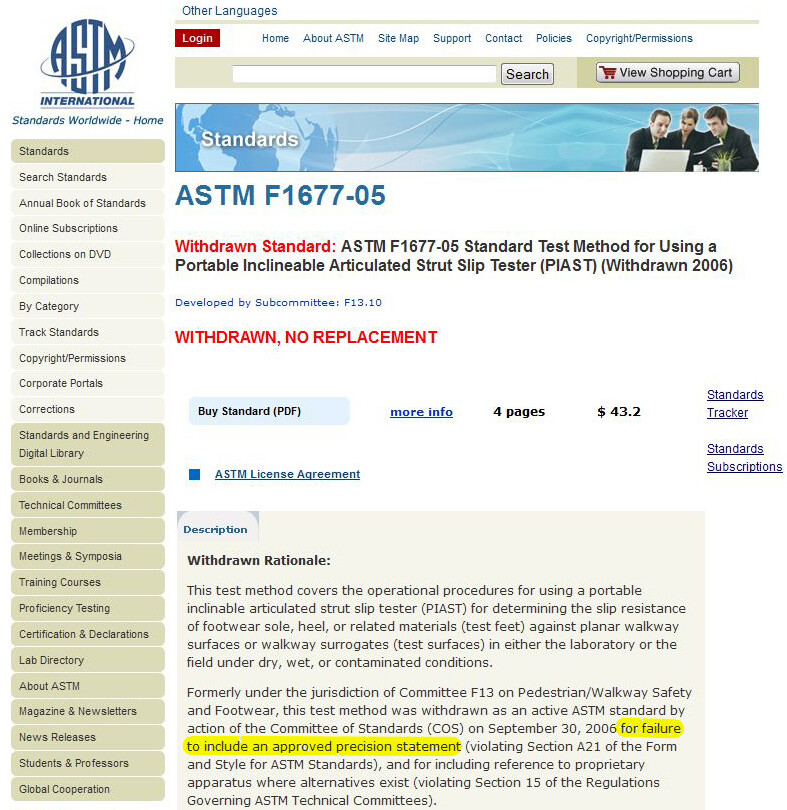
Slip and fall expert witnesses in the United States frequently rely on either the English XL Variable Incidence Tribometer (VIT) or the Brungraber Mark IIIB. What is troubling is that neither instrument currently has a published, peer-reviewed ASTM test method in force in any country, and both trace back to ASTM standards (F1677 and F1679) that were withdrawn in 2006. Those withdrawals were based in part on the failure to produce acceptable precision and bias statements after years of requests. A recent study showed these instruments lack the precision necessary to be considered scientific devices to assess floor safety.
Precision is not a technicality. Precision is foundational. If a device cannot demonstrate repeatability and reproducibility under laboratory conditions, then the reliability of its measurements in litigation settings deserves serious scrutiny.
The original ASTM standards tied to these devices were listed as withdrawn after the Committee on Standards determined they lacked approved precision statements and referenced proprietary apparatus where alternatives existed. That is not a minor procedural issue — it goes directly to scientific reliability.
Lack of Precision and Published Standards
ASTM F1677 (Brungraber Mark II) and ASTM F1679 (English XL) were both published in 1996 and later withdrawn in 2006. OSHA initially incorporated those standards in 2001 but later revoked incorporation, noting concerns that required validation elements had not been satisfied. OSHA rejected these instruments due to the fact that these instruments were not likely to ever be able to produce a reasonable precision statement.
The Brungraber Mark IIIB is often described as an evolution of the Mark II. However, no current ASTM standard exists for the Mark IIIB, and no published precision statement has been adopted for it. The English XL likewise operates today without an active ASTM test method.
In In-Joo Kim’s Pedestrian Fall Safety Assessments, it is noted that interlaboratory studies involving these devices showed substantial variability across laboratories and users. That variability was part of the historical context surrounding the withdrawal of the earlier ASTM standards. The 2010 Journal of Forensic Sciences study (Powers, Blanchette & Brault) further documented that different tribometers yielded different coefficient of friction values for identical surfaces and advised caution in interpretation. This is why the Brungraber Mark II’s test method was withdrawn 0ver two decades ago.
Precision matters because Rule 702 and Daubert require reliability, testability, peer review, known error rates, and general acceptance. Without documented precision, those factors become difficult to satisfy.
These instruments measure static coefficient of friction (SCOF), which tells us how slippery a floor is to someone standing still (static) on the floor. SCOF testing is widely known to be irrelevant around the world as a safety assessment tool. This is well-documented is this ASTM publication. The user manual of the English XL clearly states that the device measures SCOF.
ASTM F2508 and the “Validation” Question
After F1677 and F1679 were withdrawn, ASTM F2508 emerged from the USC tribometer study. That study involved multiple devices and ranking surfaces in order of slipperiness.
However, ASTM F2508 does not establish precision and bias in the traditional ASTM sense. It does not provide repeatability statistics across laboratories, nor does it create a comprehensive calibration framework. Instead, it evaluates whether a tribometer ranks selected surfaces in the same order as human slip outcomes.
That is a narrower inquiry than full scientific validation. Ranking ability is not equivalent to precision, reproducibility, or defined error rates. Courts evaluating expert testimony should understand that distinction.
In the USC study, the English XL did NOT correctly rank the tiles in the proper order of slipperiness. After the study was published and the correct order was now known, the English XL got DIFFERENT readings on those tiles, and wouldn’t you know it?! Now the English XL WAS able to correctly rank the tiles in order of slipperiness. Interesting?
Why ASTM International F2508 Does Not Prove a Tribometer Is Scientifically Reliable
One of the most common tactics used by slip-and-fall expert witnesses in U.S. courtrooms is to claim that their tribometer has been “validated” under ASTM F2508. At first glance, that sounds impressive. Jurors hear “ASTM standard” and assume the device must be scientifically proven.
Unfortunately, that assumption is deeply misleading.
ASTM F2508 does not validate a tribometer’s accuracy, precision, or reliability. Instead, the standard merely asks whether the device can rank three test surfaces—a slippery one, a moderately slip-resistant one, and a more slip-resistant one—in the correct order.
That’s it.
The test does not require acceptable error rates.
It does not require repeatability.
It does not require reproducibility between laboratories.
It does not require that the instrument produce measurements close to the true value.
All the device has to do is correctly say which surface is the slipperiest, which is in the middle, and which is the most slip-resistant.
The “Three Glasses of Water” Analogy
To understand how absurd this is as a validation method, imagine trying to validate a thermometer the same way.
Picture three glasses of water in front of you:
- One glass contains ice-cold water
- One contains room-temperature water
- One contains steaming hot water

If your eyes can look at those glasses and determine which one is the hottest, which one is the coldest, and which one is in the middle, would that make your eyes a valid thermometer?
Of course not.
Your eyes might correctly rank the three glasses by temperature, but they cannot measure temperature, cannot produce accurate readings, and cannot generate reproducible data. No scientist would ever accept such a method as proof that a thermometer works.
Yet that is essentially what ASTM F2508 does for tribometers. Guess who wrote ASTM F2508….users of the Brungraber Mark IIIB who ran the USC study used to create it. No test standard? No problem. We’ll make something up that “validates” our tribometers. But F2508 validates that the users of these devices are desperate.
Ranking Is Not Measurement
Scientific measurement instruments must demonstrate several fundamental characteristics before they are considered reliable:
- Accuracy – How close the measurement is to the true value
- Precision – How consistent repeated measurements are
- Repeatability – Whether the same operator gets the same result repeatedly
- Reproducibility – Whether different operators or labs get similar results
- Known error rates
ASTM F2508 addresses none of these.
A tribometer could produce wildly inconsistent numbers, large errors, and poor repeatability—and still pass F2508—as long as it can roughly rank three predefined tiles.
That is not scientific validation. It is merely a sorting exercise.
Why This Matters in Court
Slip-and-fall litigation often hinges on whether a floor was “too slippery.” When an expert witness brings a tribometer into court and claims it has been “validated under ASTM standards,” the implication is that the instrument has undergone rigorous scientific testing.
But if that claim rests solely on ASTM F2508, the jury is not being told the full story.
Passing F2508 does not prove that the device can measure slip resistance accurately. It only proves the device can distinguish between a very slippery tile and a less slippery one—something that many crude or inconsistent instruments could do.
In other words, ASTM F2508 can be used to give an appearance of scientific legitimacy to devices that may lack the precision required for meaningful measurement.
I have all the “receipts” (the websites of published studies showing that the English XL has no precision, the website showing the lack of anything useful coming from the ASTM F13 committee, the “Federal Register” from OSHA where they rejected both the Brungraber and the English XL, etc., etc.,etc.) all in a tight little pdf file that tells the story well and catches these full-time “experts” in a ton of false statements that you can pressure them with. Contact me for a copy.
The Bottom Line
A true scientific validation standard would require demonstrated accuracy, repeatability, reproducibility, and known error rates. ASTM F2508 requires none of these. It simply asks whether a tribometer can correctly rank three surfaces by slipperiness.
That is not validation.
It is the tribometer equivalent of claiming that your eyes are a thermometer because you can tell which of three glasses of water is hot, warm, or cold.
And that is why courts, attorneys, and judges should carefully examine claims that a tribometer is “validated” under ASTM F2508 before accepting it as reliable scientific evidence.
The “0.50 Is Safe” Assertion
Another recurring issue in litigation is the statement that “0.50 is generally accepted as safe.” That number traces historically to static coefficient of friction testing involving the James Machine and floor wax under clean dry conditions. The Access Board claims (ADA) they don’t know what number constitutes “safe”.
Static coefficient of friction (SCOF) measures resistance to movement from a stationary state. Most real-world slips occur during motion, often under wet or contaminated conditions. International research bodies, including the UK Health and Safety Executive, have emphasized dynamic testing for decades.
Different instruments have different safety criteria. A universal “0.50 equals safe” claim oversimplifies tribology and conflates distinct methodologies.
Court Decisions Addressing Reliability
Courts have examined these issues.
- Michaels v. Taco Bell Corp. (2012) excluded English XL testimony in part due to calibration and reliability concerns following ASTM withdrawal.
- Steffen v. Home Depot (2014) referenced the JFS study cautioning that different tribometers yield different results.
- Fedor v. Freightliner (2002) excluded friction testimony lacking discernible methodology.
- Boucher v. Venetian (2022) applied Nevada’s Hallmark reliability standards.
- Page v. Supervalu (2015) addressed training and experience concerns related to Mark IIIB use.
- Baugus v. Wal-Mart (5th Cir. 2014) upheld exclusion of unreliable methodology.
These rulings do not create categorical bans on specific devices, but they show that courts scrutinize reliability carefully when precision and methodology are challenged.
The International Contrast
The British Pendulum Tester, by contrast, has published standards in over 50 nations and decades of interlaboratory research. ASTM E303-22 now reflects closer alignment with international pendulum methodologies used across Europe, Australia, and Asia.
Whether one prefers pendulum testing or another method, the difference in documented international adoption and precision research is material. Here is what the United Kingdom’s Health and Safety Executive (their version of OSHA) has to say on the matter of testing floors accurately for slip risk (there is no mention of Brungrabers or English XL’s here.)
Sotter Engineering has been testing floors for Ford Motorcars (in three of their Mexican manufacturing plants), the Porsche Experience, Disney, Unilever, the United States Navy and Space Force, General Motors, Amazon, Apple, Great Wolf Lodges, the Cities of San Francisco, Boston, New York, Oakland and Los Angeles, Universal Studios, the Ritz Carlton, Google, Kohler Baths, Masco, QuikTrip Convenience Stores, the YMCA, Viejas Casino, Carnival Cruise Lines, EJ Gallo Wines, Chik-fil-A, Virgin Voyages, Raising Cane’s, Royal Caribbean, Montage Resorts, Polyflor, Polycor, and well over a thousand other clients in many countries to help them stop slips on their properties using the pendulum DCOF tester. All that experience has made us one of the world’s most accurate and reliable slip resistance test labs today.
None of those companies requested testing with the Brungraber Mark IIIB or the English XL, but I do recall a Hilton Resort in Panama City Beach, Florida telling me that they did hire a guy with an English XL to assess the slip resistance of their floors, and the answers he gave them were nonsense. He said the slippery floors they were working on solutions for weren’t slippery, and he told them the floors they had no issues with for ten years were too slippery. They fired that guy. They then did some homework online and found Sotter Engineering, and had us test their floors and tubs for several years, flying me across the country twice a year.
I also recall some guys who were full-time professional expert witnesses asking to come to my lab to be introduced to the pendulum tester. Three men came, and this was sometime in early 2025. One of these men admitted to me that when working for defense attorneys, the English XL worked great. You simply had to push the instrument down on the floor harder when taking measurements to get higher readings. You could produce false readings on a slippery floor that said it wasn’t slippery using the English XL and applying more force to the instrument when taking the readings.
They said that they wanted to perhaps purchase a pendulum tester because when working for plaintiff’s attorneys, it was harder to produce the data they needed to produce. Often the English XL would say a floor wasn’t slippery when they were getting paid to say that floor WAS slippery. So they were considering buying a pendulum to get accurate readings if floors were indeed slippery and they were working for a plaintiff attorney, and they needed to say a floor was indeed slippery because often the English XL was not capable of saying a slippery floor was slippery.
Another true story: a man came to my lab to be trained how to use the pendulum. He told me that he had a tile and each day he would take a reading of it with his English XL. Then he would carefully clean it identically every day, put the tile in a sealed box, and put it under his bed. Each and every day for a month he carefully re-tested that same clean tile with his English XL. He told me that he never got the identical reading on that same tile twice in 30 days of testing the tile.
ASTM Governance and Committee Dynamics
ASTM committees are composed of volunteers from industry, consulting, manufacturing, and academia. Committee leadership rotates. Disagreements about standards development are common in technical fields.
It is fair to debate whether more robust precision studies should be required before devices are used in litigation. It is fair to argue that F13 has not published a current comprehensive slip-resistance field standard. It is also fair to question whether committee structure and voting dynamics affect publication outcomes.
However, the core scientific issue remains precision, peer review, reproducibility, and error rate. One gem produced outside of F13 is ASTM D2047, which measures how slippery a clean and dry floor is to someone standing still (static) on that clean and dry floor. That’s the ASTM’s current safety standard, since F13 will apparently not publish one after F1677 and F1679 were withdrawn for “lack of a reasonable precision statement”.
On Litigation Incentives
Slip and fall litigation is economically significant. Experts are compensated for testimony. That is true across disciplines — engineering, medicine, accident reconstruction, biomechanics.
The adversarial system creates incentives on both sides. That makes methodological rigor even more important. Devices lacking documented precision are more vulnerable to manipulation — not necessarily because users act improperly, but because variability allows greater interpretive flexibility.
Courts are tasked with guarding against unreliable methodology under Rule 702.
Summary
The central issues are:
- Withdrawn ASTM standards (F1677 and F1679)
- Absence of approved precision statements
- Documented inter-device variability
- No international adoption of certain devices
- The narrow scope of ASTM F2508
- Repeated judicial scrutiny under Daubert
These are not personal disputes. They are methodological questions.
If expert testimony relies on instruments without documented precision, peer-reviewed methodology, or general acceptance in the relevant scientific community, then admissibility challenges are appropriate.
The reliability standard under Rule 702 is not optional. It is foundational.
And in slip resistance litigation, precision matters.