

For years, the National Floor Safety Institute promoted its B101 series as a benchmark for slip resistance in the United States.
Today, that framework exists without ANSI accreditation, without federal adoption, and without clear evidence that it reduces real-world slip-and-fall injuries.
That’s not a minor issue.
That’s a credibility problem.
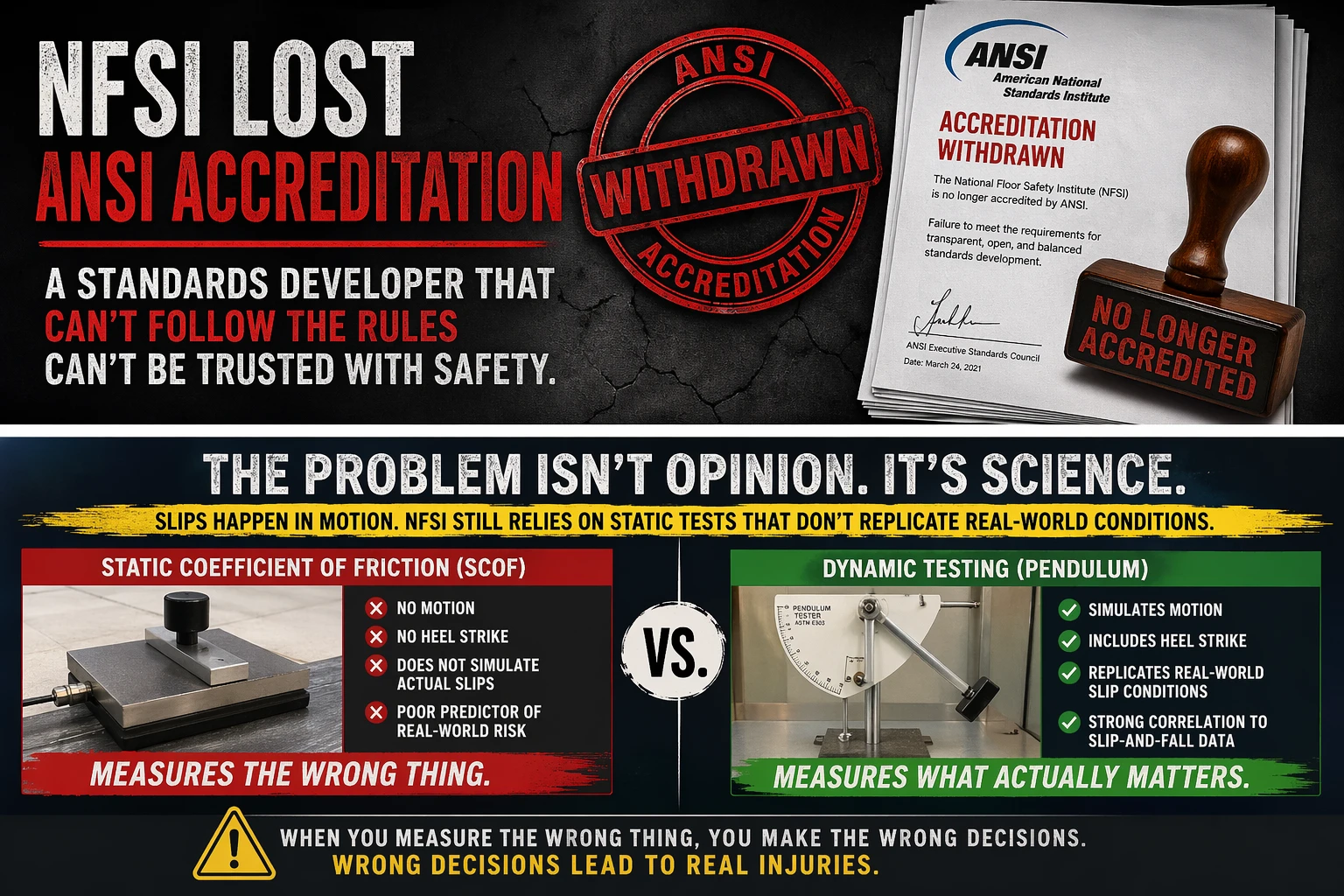
1. Loss of ANSI Accreditation Is a Big Red Flag
American National Standards Institute does not withdraw accreditation lightly.
It requires:
- Transparent consensus
- Balanced participation
- Public review
- Documented, repeatable procedures
When those conditions are not met, accreditation is removed.
What that means:
The development process behind these standards did not meet the baseline requirements expected of nationally recognized standards bodies.
2. Federal Regulators Did Not Adopt the System
The U.S. Consumer Product Safety Commission reviewed NFSI-related petitions multiple times.
They declined to adopt them.
Why that matters:
- No demonstrated link to injury reduction
- No consistent, reproducible performance across users
What that means:
A rating system was presented—and federal regulators were not convinced it improves safety.
3. The Science Has Not Been Independently Verified
Groups such as the Tile Council of North America have pointed to:
- Limited peer-reviewed validation
- Lack of open methodology
- Restricted access to underlying data
What that means:
If a method cannot be independently tested and reproduced, it cannot be relied upon as scientific evidence.
4. The Core Problem: Measuring the Wrong Thing
At the center of this issue is a fundamental flaw:
Many of these systems rely on static coefficient of friction (SCOF).
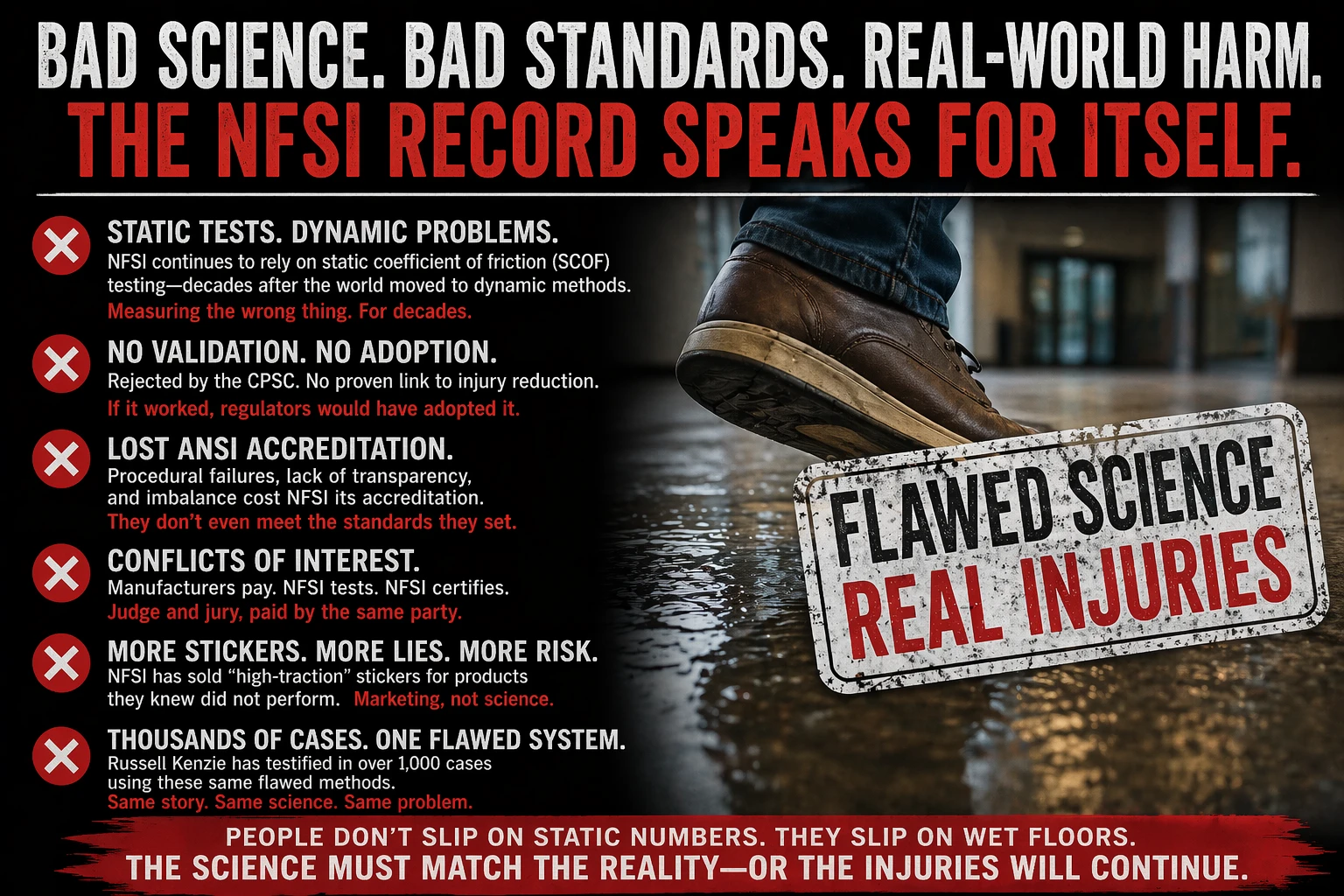
But slips don’t happen in static conditions.
They happen:
- During motion
- At heel strike
- Under dynamic load
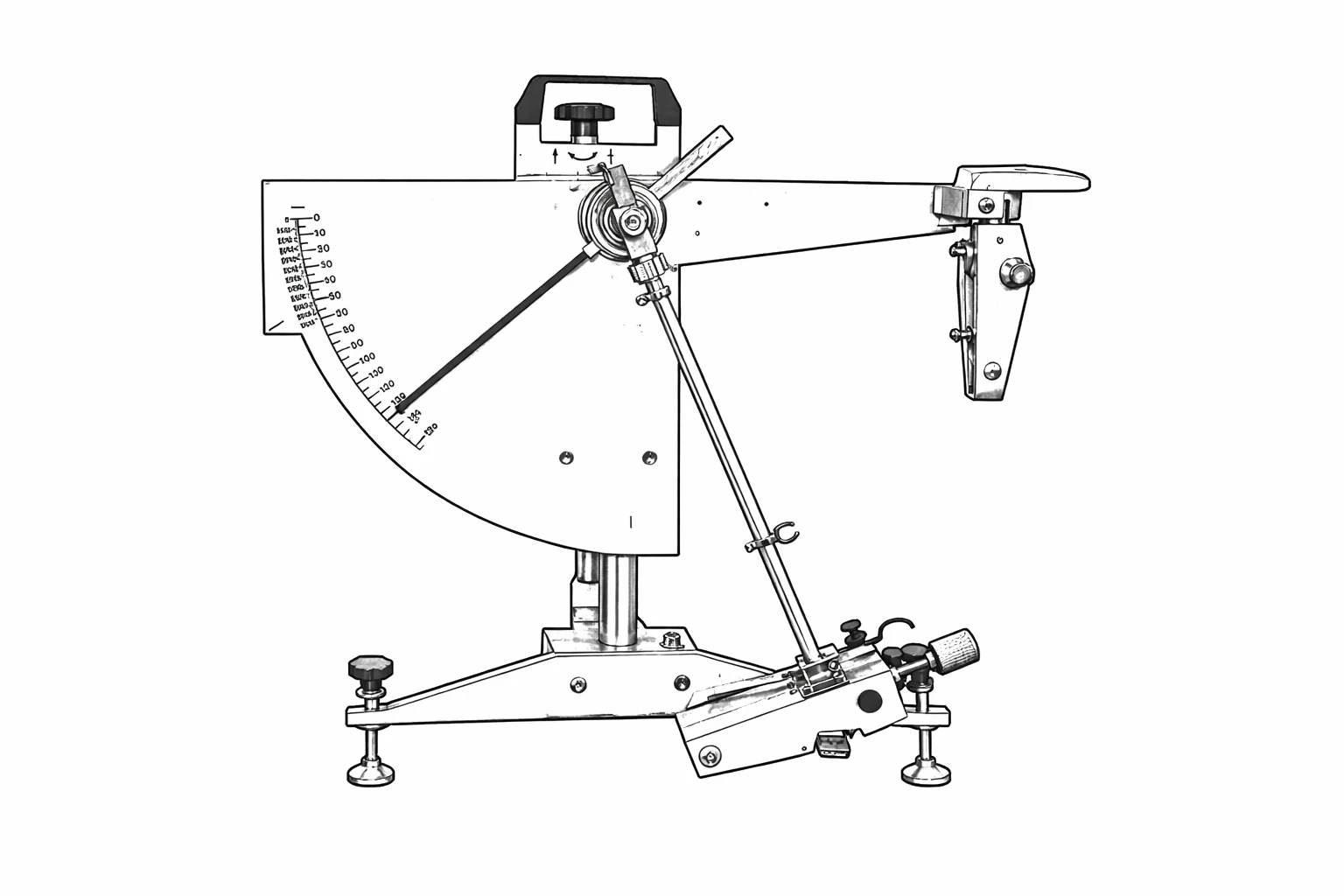
That’s why internationally accepted methods use dynamic testing, mostly using the pendulum tester, including:
- ASTM E303
- AFSA FS101-25
- BS/EN 16165:2021
- AS/NZS 4586
What that means:
If you measure the wrong physical condition, you get the wrong answer—consistently. That’s convenient when you have a vested interest in giving a “passing grade” to every client who gives you money … because then you can get more money from them to get the NFSI “seal of approval”.
5. Why This Matters in Court
Slip resistance testing is frequently introduced as “scientific evidence.”
But not all testing methods meet that standard.
If a method:
- Lacks precision
- Has not been adopted by regulators
- Lacks independent validation
- Does not simulate real-world conditions
- Is based on “research” that is hidden from people who would like to see it
…then its conclusions should be carefully examined before being relied upon in litigation.
What that means:
The reliability of the opinion depends entirely on the reliability of the method.
6. A Pattern Worth Examining
In litigation, some experts continue to rely on legacy methods rooted in static testing.
That raises a straightforward question:
If the industry has long recognized that slip events occur under dynamic conditions, why continue to rely on static measurements?
That question goes directly to weight of evidence. Anyone using static testing methods (NFSI B101.1, English XL, Mark IIIB, ASTM D2047) certainly could never be called “experts” in this field of study. Everyone around the world now knows that static tests are misleading at best, and potentially fraudulent when presented under oath as a valid safety assessment.
7. Legacy Devices Lost Their Standards—and Why That Matters
It’s also important to understand that several commonly cited U.S. slip test devices are no longer supported by active ASTM standards.
Both the Brungraber Mark II and the English XL were previously associated with ASTM F1677 and ASTM F1679. These standards were withdrawn in 2006, in part because they lacked acceptable precision statements—meaning the methods could not demonstrate consistent, repeatable results across different users and conditions.
The lack of precision for both the English XL and the newer version of the Brungraber Mark II (the Brungraber Mark IIIB) was documented in a peer-reviewed, published study in 2020. So these devices certainly haven’t fixed their precision problems in the 20 years since their test methods were withdrawn.
No other nation, incidentally, ever had a published test method for any of these devices. They are only used in American courtrooms. Other published studies show the English XL lacks accuracy in predicting whether a floor will cause slips.
In addition, both devices measure static coefficient of friction (SCOF), not dynamic conditions.
Key point:
If a method cannot demonstrate precision—and does not replicate how slips actually occur—its reliability as a safety assessment tool is fundamentally doomed.
Real Scientific Devices Must Show Precision!
Final Thought
This is not about personalities.
It is about whether the tools used to evaluate safety:
- Reflect real-world conditions
- Produce consistent results
- Meet accepted scientific standards
Because when the method is flawed, the conclusion is flawed—and in slip-and-fall cases, that has real consequences. In other words, when a method measures the wrong condition, it doesn’t just produce error—it produces confidence in the wrong answer.