

In the United States, a serious misunderstanding has taken hold in the flooring industry.
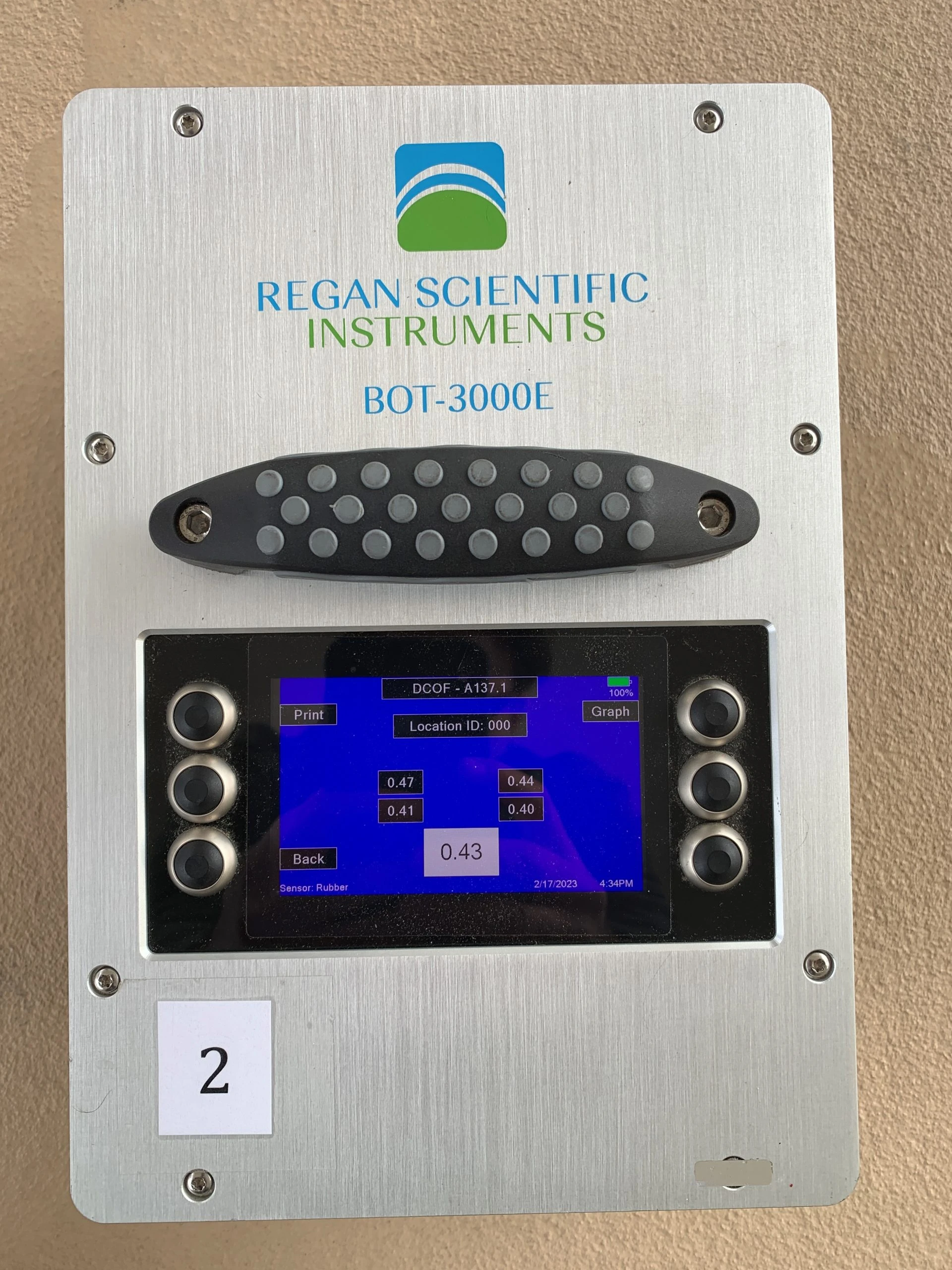
Many architects, attorneys, insurers, manufacturers, and even safety consultants believe that the BOT-3000E tribometer determines whether a floor is “safe.” It does not. And the standard behind it — ANSI A326.3 — clearly says so.
What ANSI A326.3 Actually Says
ANSI A326.3 is a test method developed within the American flooring industry. It uses the BOT-3000E to measure a surface’s dynamic coefficient of friction (DCOF). But here is the critical and often ignored point:
The standard explicitly states that it is not intended to assess pedestrian safety or human slip risk.
It is intended to compare surfaces under controlled conditions. That distinction is not subtle. It is fundamental. A comparison tool is not a safety assessment tool.
Yet ANSI A326.3 results are routinely presented in marketing materials, specifications, and courtrooms as proof that a floor is “safe”. That is not what the ANSI A326.3 standard claims. Here’s what it does say. The ANSI A326.3 test “can provide a useful comparison of surfaces, but does not predict the likelihood a person will or will not slip on a hard surface flooring material.” That clearly states it should not be used as a “safety test.”
Why did the Tile Council of North America (TCNA) put that statement in the test method? Because 0.42 is super easy to achieve, even for slippery floors, and the BOT-3000E has some serious issues when it comes to identifying slippery floors. Watch the video further down the page just above the section called, “The Real Issue”. You’ll see for yourself that the BOT-3000E can often call a slippery floor “not slippery”, and it often says a floor that is not slippery is “slippery.”
A Comparison Tool — Not a Safety Tool
The BOT-3000E measures drag force using a curved rubber slider pulled across a wet surface at a controlled speed. Humans do not walk that way.
Real slip events occur during the first milliseconds of heel strike and involve:
- Impact velocity
- Micro-slip
- Rotational forces
- Changing angles of contact
- Dynamic body movement
The BOT-3000E does not replicate heel strike biomechanics. It provides a mechanical friction number for surface comparison. That is its design purpose. And that’s why the European Union abandoned using this device as a safety assessment tool decades ago. It just doesn’t effectively assess safety.
The Industry Conflict
ANSI A326.3 was created within the American flooring industry, and it performs one useful function for that industry:
It allows surfaces to be compared to one another under standardized conditions. But problems arise when that comparison number is interpreted as a measure of safety. In practice, the BOT-3000E often produces results that do not align with real-world pedestrian experience. It can:
- Classify slippery floors as acceptable
- Flag surfaces that perform well under heel-strike testing as problematic
Those inconsistent and sometimes counterintuitive readings reinforce what the standard itself already states:
It is not a safety assessment method.
When a test generates results that contradict observable pedestrian performance, that is not evidence of superior science — it is evidence of scope limitation.
Ignoring the Fine Print
Despite the explicit language in ANSI A326.3, the BOT-3000E is frequently used as if it were a definitive safety instrument. Deceptive marketing implies compliance equals safety. Specifications rely on it as proof of slip resistance. Expert testimony sometimes treats it as determinative of safe conditions. But the standard does not support those conclusions.
Using a method outside its stated intent is not scientific rigor. It is methodological overreach.
Here are just a few of the disclaimers in the ANSI A326.3 test method:
“Unless otherwise declared by the manufacturer, hard surface flooring materials suitable for level interior spaces expected to be walked upon wet with water shall have a measured wet DCOF of 0.42* or greater when tested using SBR sensor material and SLS solution as per this standard. However, hard surface flooring materials with a DCOF of 0.42* or greater are not necessarily suitable for all projects. The specifier shall determine materials appropriate for specific project conditions, considering by way of example, but not in limitation, type of use, traffic, expected contaminants, expected maintenance, expected wear, and manufacturers’ guidelines and recommendations.” How do you “consider” those factors? It’s up to you, I guess. The test method offers no guidance on that whatsoever.
Section 3.2 states: “…hard surface flooring materials with a measured wet DCOF of less than 0.42*… shall only be installed when the surface will be kept dry when walked upon and proper safety procedures will be followed when cleaning the hard surface flooring materials.”
The United Kingdom’s Health and Safety Executive (HSE), which is England’s version of OSHA, warned against using these types of drag-sled machines to assess slip risk. (see page 6 under “Other Tests”.) The HSE says in their recommendations that, “The instruments that have been dubbed ‘sled tests’ [like the BOT-3000E and TRACSCAN 2.0] involve a self-powered trolley that drags itself across the floor surface. These tests do not recreate the conditions of pedestrian gait which give rise to most slip accidents. Data from such machines is unlikely to be relevant to pedestrian slipping in contaminated conditions.”
The latest version of the ANSI A326.3 test standard, with the help of lawyers who aim to protect the creators of this test, goes on to say, “Because many variables affect the risk of a slip occurring, the measured DCOF value shall not be the only factor in determining the appropriateness of a hard surface flooring material for a particular application. Further, while structure (e.g. three-dimensionally patterned or profiled surfaces) can assist in drainage….such surfaces can produce misleading measured DCOF values due to test device constraints.” Notice the quotation marks? That’s a direct quote from the test.
In other words, just because you get above a 0.42 doesn’t mean much of anything in regards to safety, and you may get misleading results in many situations using the BOT-3000E.
Footnote 1 says, “No claim of correlation to actual footwear or human ambulation is made.”
Again, in the introduction to the test method, it says that this test “can provide a useful comparison of surfaces, but does not predict the likelihood a person will or will not slip on a hard surface flooring material.”
An informative note (on page 3 of the ANSI A326.3 test method) says, “Normative measured DCOF limit values are not provided in this standard for exterior applications, interior ramps and inclines, pool decks, shower floors, or flooring that is contaminated with material other than water or where minimal or no footwear is used.”
For some areas labeled as “Interior, Wet Plus”, such as locker rooms, public showers, self-service restaurants, etc., “…it is generally accepted that hard surface flooring in this category should have AT LEAST A MINIMUM wet DCOF of 0.50*, with factors other than wet DCOF also taken into consideration. Such factors include, but are not limited to, expected contaminants, drainage, surface structure, effect of structure on the DCOF measurement, number of grout joints, traction-enhancing features, and intended use in addition to the other criteria in this standard…[so]…a single normative DCOF limit value is not provided.”
What Actually Assesses Slip Risk?
If the real question is: “Is this floor safe for pedestrians?” There is a globally recognized answer:
The Pendulum Test
The pendulum tester replicates heel strike. It measures energy loss during impact, which closely reflects how slip events actually occur.
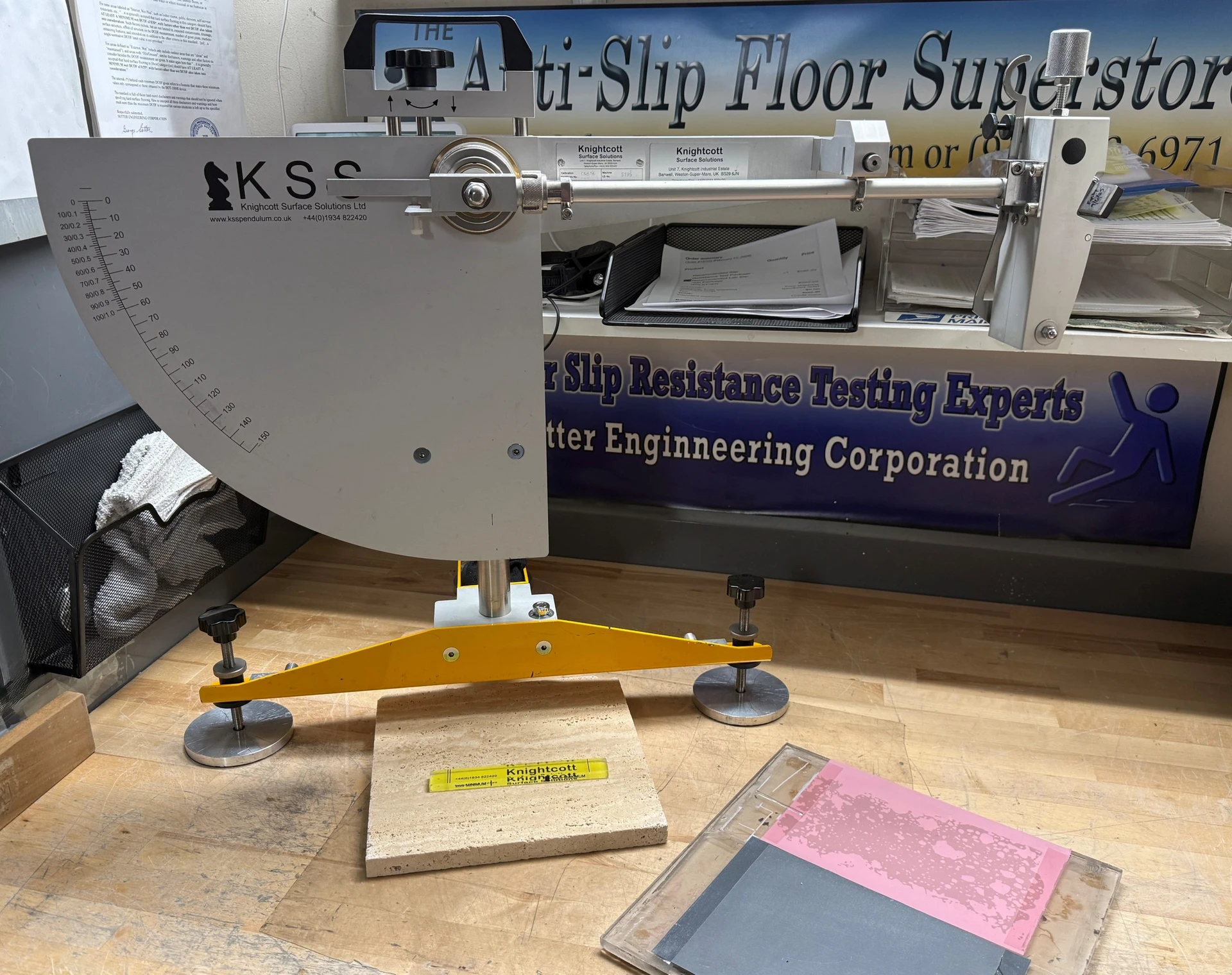
It is standardized under:
- ASTM E303 (United States)
- British pendulum test methods, UKSRG Guidelines and BS 16165:2021
- Australian Standard AS 4586 and AS 4663
- European Standard EN 16165:2021
The pendulum method has been studied for decades. It has epidemiological support. It is peer-reviewed. It has a peer-reviewed, published test method in more than 50 nations worldwide. The BOT-3000E has one, and it is so full of disclaimers that you may as well “chuck it in the bin”, as they’d say in the UK.
The pendulum DCOF tester is, by any objective measure, the most researched and internationally accepted pedestrian slip resistance test in the world.
Unlike ANSI A326.3, pendulum methods are explicitly intended for assessing pedestrian slip risk.
That is the difference.
The Only Proper Use of the BOT-3000E
The BOT-3000E does have a role — but only when used properly.
Here is how it can be used responsibly:
- First, assess the floor’s safety using a pendulum test method (such as ASTM E303 or another recognized pendulum standard).
- Determine whether the floor is safe based on heel-strike testing.
- Then measure the same surface with the BOT-3000E.
At that point, the BOT-3000E can be used for what it was designed to do:
Compare surfaces.
Or more specifically:
- Monitor changes over time
- Compare friction values before and after cleaning
- Detect deterioration from heavy foot traffic
- Evaluate the impact of destructive cleaning methods
- Identify whether maintenance procedures are altering surface friction
In this way, the BOT-3000E can function as a monitoring device.
If its readings begin to shift significantly over time, that may indicate the need to perform another pendulum test to reassess actual pedestrian safety.
Used this way — after safety has already been established by pendulum testing — the BOT-3000E stays within its intended scope. Used as a standalone safety determination tool, it does not.
Global Acceptance vs. Domestic Convenience
Much of the world relies on pendulum-based methods for slip risk assessment.
The United Kingdom. Australia. The Europe Union (France, Germany, Italy, Spain, etc.,etc.,etc.). Singapore. Israel. Dozens of other nations.
The United States flooring industry often relies on ANSI A326.3 instead because that 0.42 DCOF is super easy to obtain for slippery surfaces. But product classification convenience is not the same thing as pedestrian safety science.
The pendulum was developed for human slip risk in the USA around 70 years ago, but improvements have been made to the original device, and the test methods for its use, over the years to make it more accurate, reliable and precise. Repeatable, reproducible.
ANSI A326.3 explicitly was not. The video below shows the ANSI A326.3 test “blowing it”, as we say. It calls a slippery floor “safe”, and it says a very slip resistant floor is “slippery”. After being one of the first people to be given a BOT-3000, and then a BOT-3000E, I can tell you that this happens often.
Why were we given these devices for free? Because we are experts in this field of study. It’s all we’ve been doing for decades. The manufacturer wanted us to identify problems with the machine and help make it more useful, such as finding a soft rubber slider to use with it. No-one has ever found a soft rubber slider that gives results that make any sense for the BOT-3000E, so it cannot be used for barefoot situations. We identified problems with the machine. Those issues were ignored.
The Real Issue
The issue is not whether the BOT-3000E can generate a number. It can. The issue is whether that number answers the safety question. ANSI A326.3 says it does not.
The unpredictable and sometimes contradictory readings the machine produces on many surfaces further validate that it should never be used as a definitive safety assessment tool. If a method’s own scope says it is not intended to assess safety, presenting it as proof of safety misrepresents its purpose.
If Safety Is the Question, Use the Right Tool
When evaluating pedestrian slip risk:
Use ASTM E303 or another pendulum test method, such as BS 16165 or AS 4586. Use a test designed to simulate heel strike and correlate with real-world walking.
Then, if you wish to compare surfaces or monitor change over time, use the BOT-3000E within its intended role.
Safety assessment first. Surface comparison second.
Intent matters. Scope matters. And when the stakes include catastrophic injury, litigation, and public trust, using the correct test method is not optional — it is essential.