

Understanding ASTM F2913 and Why ASTM E303 Still Matters
For years, confusion has surrounded the question:
What is the correct ASTM-recognized way to assess the slip resistance of a walking surface?
Many people believe the answer lies in handheld static coefficient-of-friction (COF) devices. Others insist that pendulum-type testers are outdated or “not ASTM-approved for safety assessment.”
Both positions miss something critical.
Hidden in plain sight is a little-known ASTM guide — published quietly, rarely discussed, and widely misunderstood — that actually clarifies the issue.
That document is ASTM F2913, and when it is read alongside ASTM E303, a much clearer picture of ASTM’s position on walkway safety emerges.
What ASTM F2913 Actually Is — and What It Is Not
ASTM F2913 is not a test method.
It does not establish a numerical pass/fail value for slip resistance.
And it does not exist to promote any specific device manufacturer.
Instead, F2913 is a walkway safety guide developed by ASTM Committee F13 on Pedestrian/Walkway Safety and Footwear. Its purpose is to help designers, owners, and safety professionals select and evaluate walking surfaces based on how people actually walk and fall.
That framing alone is important.
F13 is not concerned with laboratory friction in the abstract — it is concerned with real-world pedestrian safety.
Dynamic vs. Static Friction: The Core Issue
Human slips occur in motion, not at rest.
When a person walks:
- The heel strikes the floor at speed
- The foot is sliding before full body weight is applied
- The available friction must resist a dynamic shear force
ASTM F2913 reflects this reality. When it discusses slip resistance assessment, it references recognized test methods that evaluate surface friction under conditions representative of pedestrian movement.
This is where pendulum testing enters the picture.
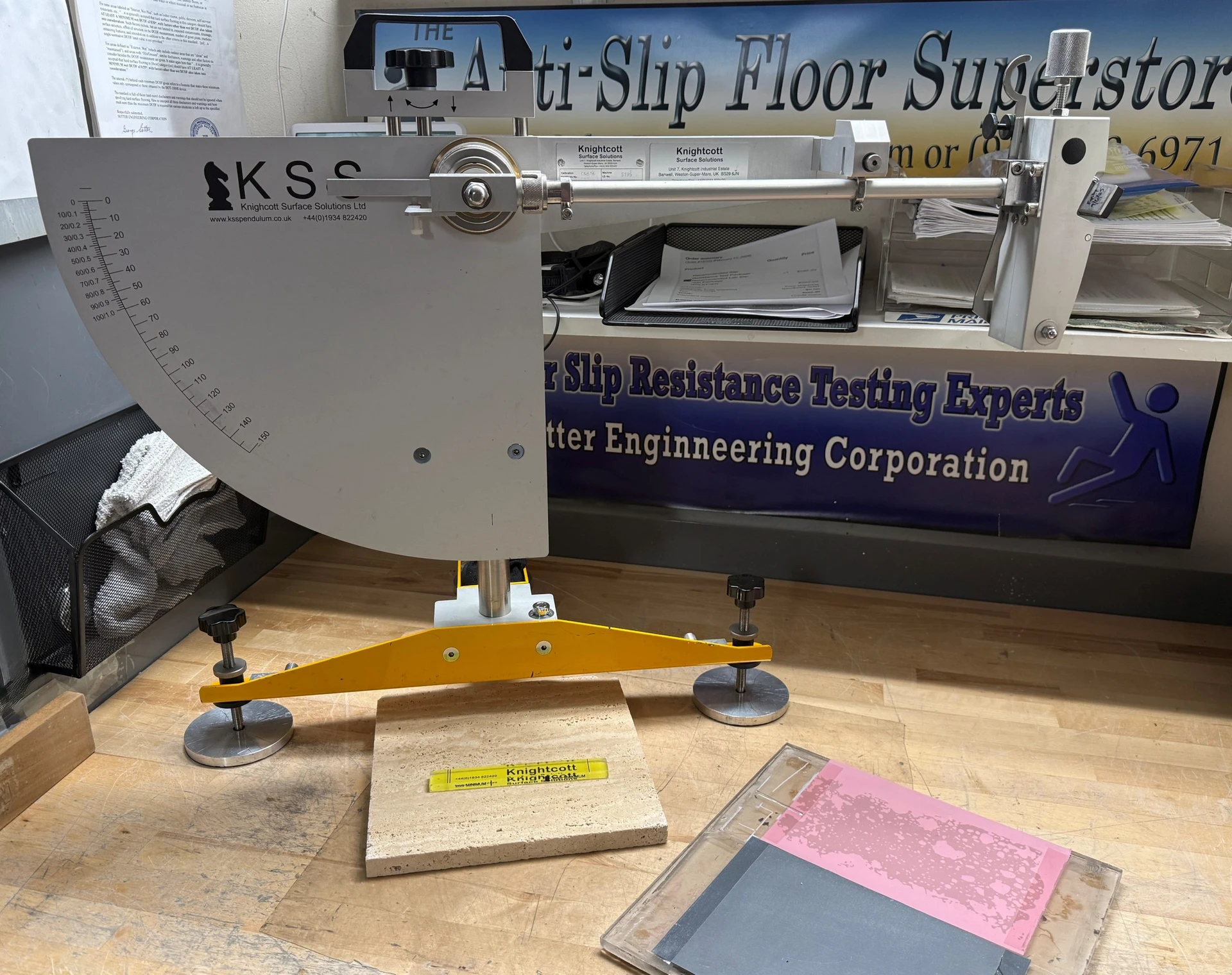
Why ASTM E303 Fits Naturally with F2913
ASTM E303, the American version of the British Pendulum Test, measures dynamic friction using a swinging rubber slider that:
- Contacts the surface at speed
- Mimics the heel-strike phase of walking
- Produces repeatable, comparable results across materials
For decades, this method has been used internationally to:
- Rank walkway surfaces
- Identify slippery conditions
- Evaluate wet and contaminated flooring
- Support safety decisions without claiming false absolutes
When ASTM F2913 refers to accepted approaches for evaluating slip resistance, ASTM E303 aligns perfectly with the intent and philosophy of the guide.
What About Static COF Devices?
Static COF testers — including devices like:
- the Mark IIIB
- the English XL
- the James Machine
measure the force required to initiate movement from a stationary condition.
That measurement can be useful for:
- Material research
- Quality control
- Comparing surface finishes under controlled conditions
But ASTM F2913 does not recognize static COF testing as a method for assessing real-world walkway safety.
Why?
Because:
- People do not fall while standing still
- Static friction ignores heel strike dynamics
- Static values often fail to predict known slip hazards
- Identical static COF values can correspond to very different slip outcomes
Notably, F2913 contains no language endorsing static COF devices as safety assessment tools — a silence that is meaningful in standards writing.
What ASTM F2913 Quietly Did
Without fanfare, ASTM F2913 accomplished something important:
- It reframed slip resistance around human movement
- It aligned walkway safety with dynamic friction principles
- It avoided endorsing devices that cannot replicate walking mechanics
- It implicitly validated the continued use of pendulum-type testing for safety assessment
This is likely why so few people noticed it.
F2913 did not attack any technology.
It did not ban any device.
It simply described walkway safety honestly.
The Takeaway
When ASTM F2913 and ASTM E303 are read together, a consistent message emerges:
- Walkway safety is about dynamic interaction between foot and floor
- Slip resistance should be evaluated using methods that replicate that interaction
- Pendulum-type testers do exactly that
- Static COF measurements, while real, are not sufficient to assess pedestrian slip risk
This is not an opinion.
It is the logical result of reading ASTM’s own documents carefully.
Final Thought
The pendulum tester has survived for over 75 years — not because of tradition, but because it continues to answer the right question:
How slippery is this surface when a person actually walks on it?
ASTM F2913 quietly reaffirmed that question.
ASTM E303 continues to answer it.
And that is why, today, pendulum-type devices remain the most appropriate tools for assessing real-world walkway safety.