

There’s a hard truth in the litigation world that most jurors—and many attorneys—never stop to consider:
If someone makes a full-time living as an “expert witness,” what exactly are they an expert in?
In many cases, the honest answer is this: they’re experts at being expert witnesses.
Not practitioners.
Not innovators.
Not researchers advancing their field.
Professional testifiers.
And nowhere is this more obvious than in slip-and-fall litigation.
When an “Expert” Doesn’t Actually Practice
In medicine, you expect a physician to treat patients.
In engineering, you expect an engineer to design, build, or evaluate systems.
In architecture, you expect someone actively involved in real-world projects.
But in the courtroom, you often see individuals who:
- Don’t actively work in the industry they testify about
- Don’t operate businesses in that field
- Don’t install, maintain, or design the systems at issue
- Don’t publish peer-reviewed research, unless it conveniently makes their instrument look good, and the “peers” reviewing the research are all users of the same device, which incidentally is not used anywhere else in the world outside of American courtrooms.
- Don’t use a device that has a test method published in ANY nation on earh
- Don’t teach or advance the science
Instead, they spend 100% of their professional time:
- Reviewing case files
- Writing reports
- Giving depositions
- Testifying for whichever side hires them
Their product isn’t engineering.
Their product isn’t safety.
Their product is testimony.

The Slip-and-Fall Industry: A Case Study in Manufactured Certainty
Slip-and-fall cases are especially revealing.
Anyone who has actually worked in real-world flooring safety knows a simple truth:
Some floors are dangerously slippery. Period.
Yet there is an entire ecosystem of professional witnesses who reliably conclude:
“The floor was not unreasonably slippery.”
Almost every time.
Across the country, insurance defense firms know exactly who to call. There is a roster. A network. A repeat cast of characters who will:
- Show up
- Use questionable instruments
- Generate convenient numbers
- Conclude the floor was “safe”
And invoice accordingly.
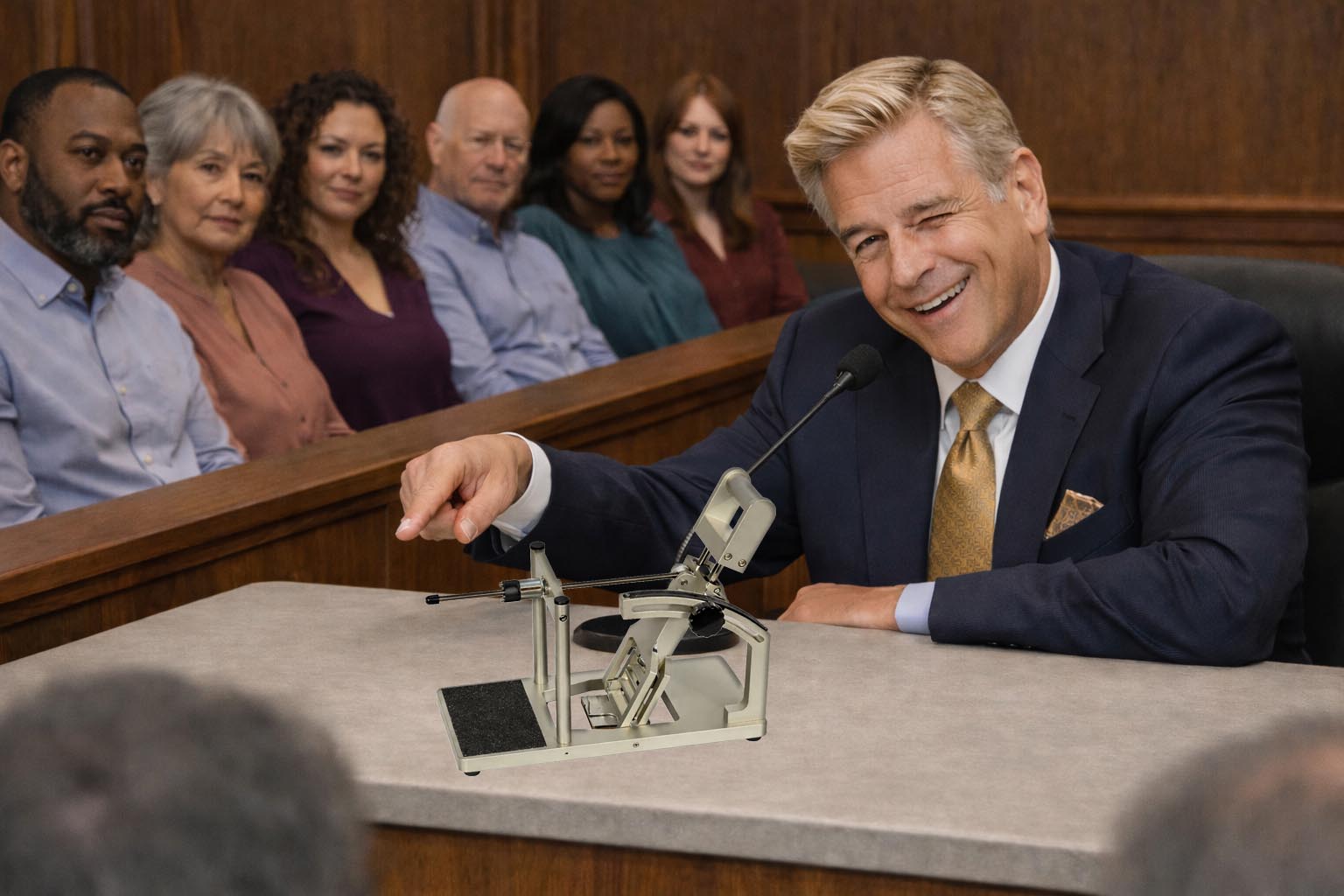
When the Instrument Is the Shield
Many of these full-time witnesses rely on devices that:
- Lack widely adopted, peer-reviewed global standards
- Have documented precision issues
- Produce highly variable results
- Can be manipulated through technique
Yet these devices are presented in court with the appearance of scientific authority.
The jurors don’t know the backstory.
The judge often doesn’t either.
But the insurance carrier knows exactly what result it’s paying for.
If the number comes in “safe,” the case becomes defensible.
If it doesn’t? The methodology gets scrutinized—or the expert quietly doesn’t get hired again.
The Financial Incentive No One Mentions
Let’s be candid.
A full-time expert witness earns:
- Hourly fees for review
- Report-writing fees
- Deposition fees
- Trial-day rates
- Travel time
- Retainers
This can easily reach hundreds of thousands—sometimes millions—of dollars per year.
But only if they remain hireable.
And remaining hireable often means being predictable.
In the slip-resistance world, predictability frequently means this:
Floors aren’t slippery.
Even when common sense says otherwise.
Even when the injured person’s life has been permanently altered.
Even when prior complaints exist.
There is a powerful financial incentive to defend the status quo.
Real Experts vs. Professional Testifiers
A true expert is usually someone who:
- Works daily in the field
- Has a reputation outside the courtroom
- Has professional risk tied to real-world outcomes
- Has nothing to gain from saying “safe” or “unsafe”
- Can point to practical experience—not just case history
By contrast, a full-time litigation consultant often has:
- No real-world operational responsibilities
- No business dependent on public safety
- No field installations
- No regulatory accountability
- No marketplace consequences
Their livelihood depends on cases—not on safer floors.
The Illusion of Objectivity
Courtroom experts often introduce themselves as “independent” or “neutral.”
But if 90% of someone’s income comes from one side of litigation—insurance defense, for example—objectivity becomes mathematically questionable.
Patterns matter.
If an expert:
- Almost always finds in favor of the defense
- Rarely identifies unsafe conditions
- Uses the same narrow methodology repeatedly
- Is hired by the same firms again and again
That’s not coincidence.
That’s a business model.
Why This Matters
Slip-and-fall cases aren’t about “easy money.”
They’re about:
- Traumatic brain injuries
- Hip fractures in the elderly
- Permanent nerve damage
- Lost independence
- Lifelong medical costs
When the scientific evaluation of floor safety becomes a litigation tool rather than a public safety tool, the system breaks down.
Unsafe surfaces remain in service.
Hazards go uncorrected.
The public pays the price.
The Quiet Reality
There is, in fact, a network of full-time expert witnesses across the country who specialize in defending premises owners and insurers in slip-and-fall cases.
They know the arguments.
They know the instruments.
They know the thresholds.
They know how to frame conclusions.
And they know exactly what result keeps the phone ringing.
That doesn’t make every expert dishonest.
But it does mean we should ask a simple question every time someone takes the stand:
“What do you actually do when you’re not testifying?”
If the answer is essentially “I testify,” then we should evaluate their opinions with appropriate skepticism.
Sunlight Is the Best Disinfectant
The legal system depends on expert testimony. It can’t function without it.
But we should stop pretending that someone who makes a living exclusively as an expert witness is automatically a leading authority in a field.
Often, they are simply highly skilled participants in litigation.
And in the world of slip resistance and floor safety, that distinction can mean the difference between accountability and avoidance.
The courtroom deserves real expertise—not professional testimony.
And the public deserves safer floors—not manufactured numbers.
The pendulum dynamic coefficient of friction (DCOF) floor slip resistance tester has a peer-reviewed, published test method in just about every country that has a standards-publishing organization in it. Over 50 nations, including the United States. Anyone pretending to be an “expert” in floor slip resistance using anything but a pendulum tester is showing themselves to be a “lair for hire”, and certainly no expert in floor slip resistance testing.