

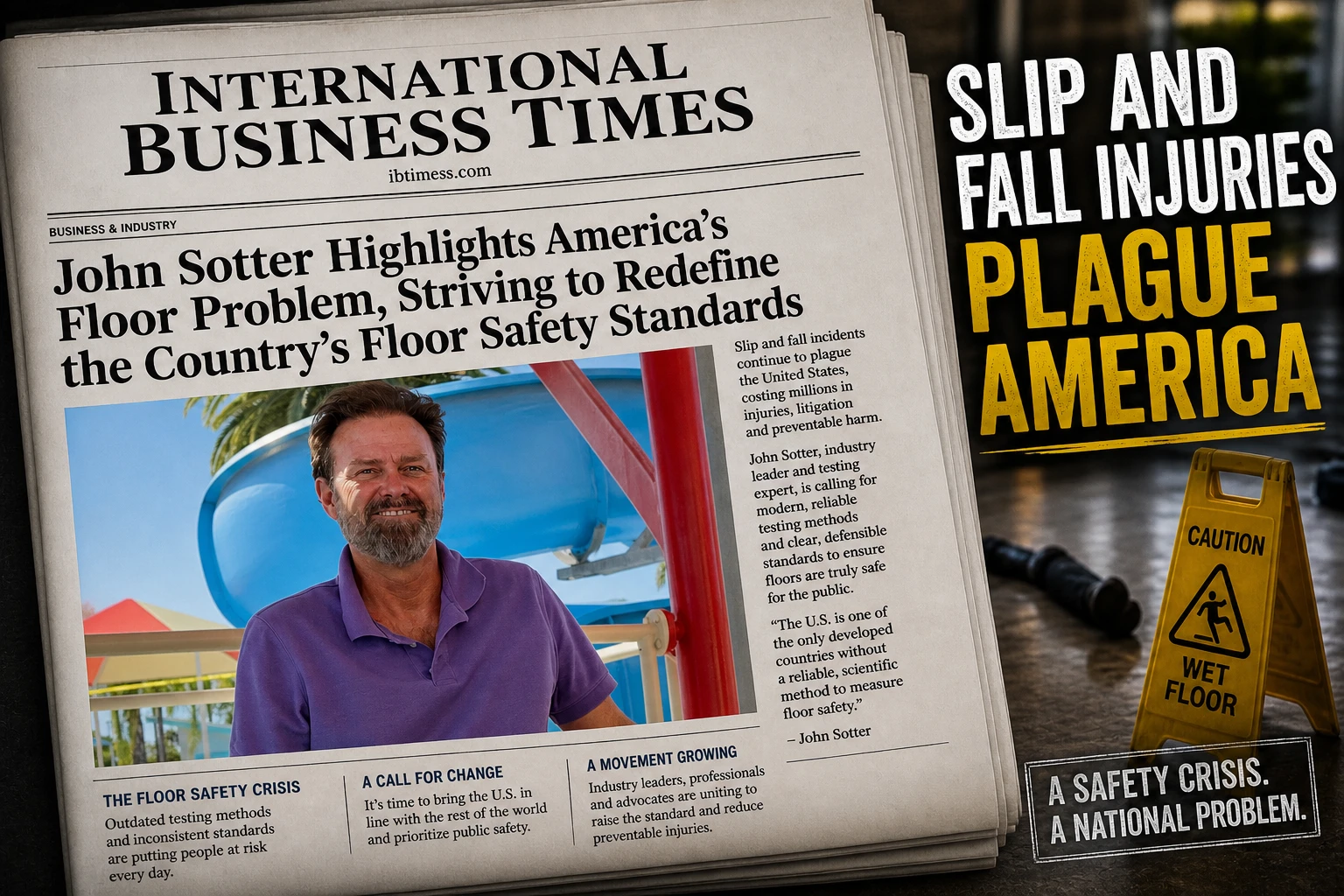
I was recently featured in International Business Times discussing an issue that continues to affect millions of people every year: unsafe walking surfaces.
Slip-and-fall injuries remain one of the leading causes of emergency room visits in the United States. And yet, despite decades of awareness, the problem persists.
Why?
Read the International Business Times article here
Because far too often, floors are evaluated using methods that do not reflect real-world conditions.
The Problem: “Compliant” Doesn’t Mean Safe
One of the key points covered in the article is something I see every day in my work:
Surfaces that technically “pass” a test… but are still dangerously slippery when people actually walk on them.
This disconnect is at the heart of the problem.
Many commonly used testing methods measure static or simplified conditions that do not represent how slip events actually occur. In the real world, slips happen during movement—during heel strike—on surfaces that may be wet, contaminated, or improperly maintained.
If the test doesn’t reflect that reality, the results can be misleading.
A Better Approach to Slip Resistance
For decades, other parts of the world have taken a more practical, field-tested approach.
Dynamic testing methods such as ASTM E303 and AFSA FS101-25 (the pendulum test) are designed to simulate real walking conditions and provide a more accurate picture of slip risk. These methods are widely used internationally and supported by decades of research.
Through the work of the American Floor Safety Alliance, we are continuing to push for the adoption of testing methods and standards that better reflect real-world conditions here in the United States.
The goal is simple:
Prevent injuries before they happen—not just measure surfaces after the fact.
Watch the Video
I put together a short video to highlight the article and explain why this issue still hasn’t been fully addressed.
The USA Has a Slip and Fall Epidemic – Read About it in the International Business Times!
In the video, I break down:
Why current testing approaches often fall short
What real-world slip resistance actually means
And how better standards published through the American Floor Safety Alliance (AFSA) can help reduce injuries and liability
If you’d like to dive deeper into this issue, you can read the full feature here:
Read the International Business Times article here
Final Thoughts
Slip-and-fall prevention is not a mystery. It’s a measurable, solvable problem—when the right methods are used.
The challenge is not a lack of knowledge.
It’s a lack of consistent, real-world application.
Until that changes, we will continue to see surfaces that are technically compliant… but practically unsafe.