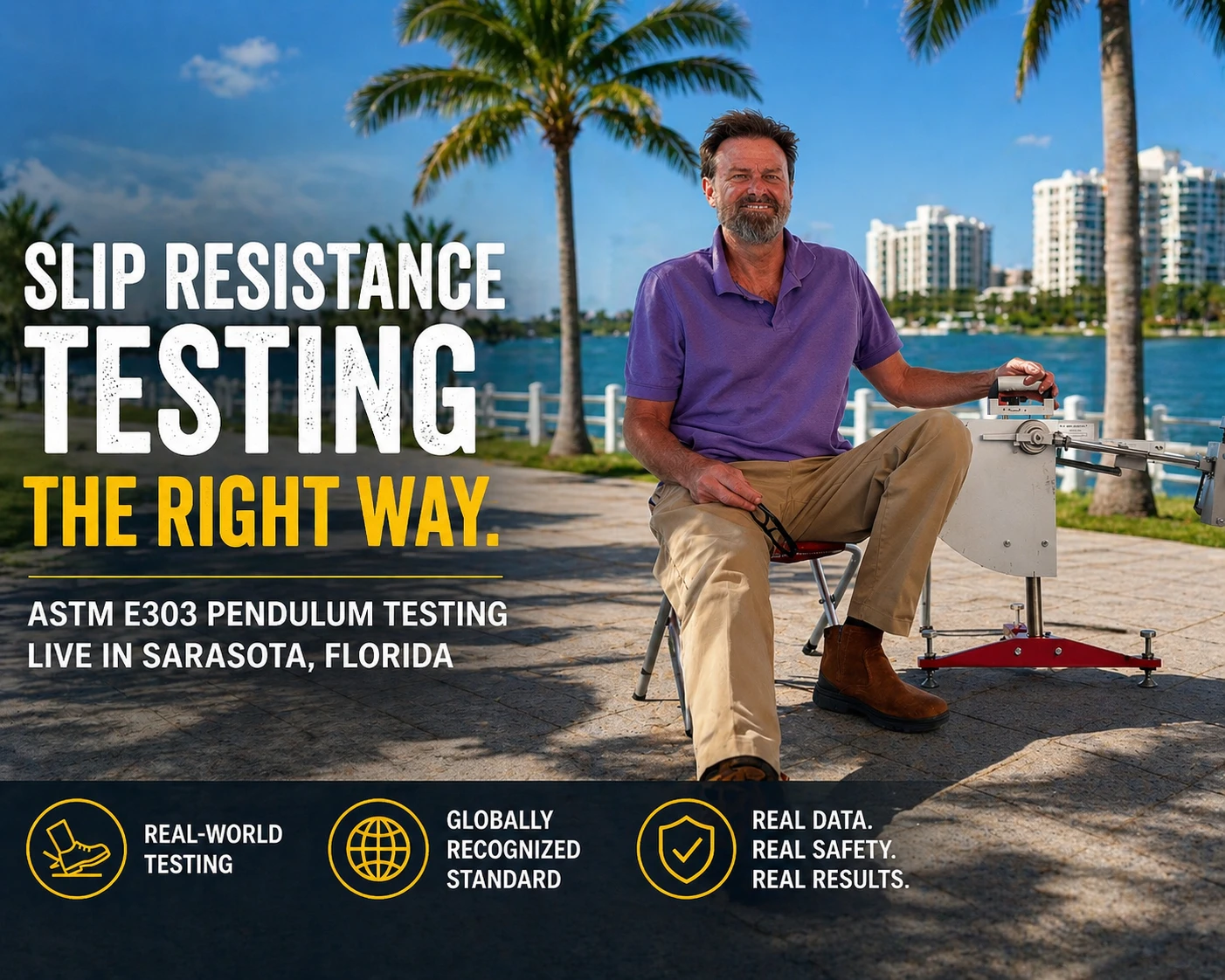
We recently conducted on-site slip resistance testing in Sarasota, Florida using the ASTM E303 pendulum tester—one of the most widely recognized and scientifically supported methods for evaluating slip risk.
Real Science Helps Stop Slip Injuries!
Unlike many commonly used devices in the United States, the pendulum test simulates a dynamic heel strike—the same motion that occurs when a person actually walks across a surface. This is critical, because slip-and-fall injuries don’t happen under static conditions—they happen in motion.
In this short video, you’ll see live testing performed on pavers on an outdoor walkway. What becomes immediately clear is how outdoor surfaces often offer plenty of real-world slip resistance.
This is why relying on outdated or non-dynamic testing methods can lead to misleading conclusions about safety. A floor that appears acceptable under one test may present a very different level of risk when evaluated using a method that reflects real-world conditions.
ASTM E303 is used globally across more than 50 countries and remains a trusted benchmark for assessing pedestrian slip risk. For property owners, contractors, and facility managers, understanding these differences is essential to making informed decisions about safety and liability.
An even better pendulum test is provided by the American Floor Safety Alliance, as it is a test written exclusively by floor slip resistance testing experts from at least two countries. Visit the American Floor Safety Alliance at https://afsa-floorsafety.com for more information on this up-to-date modern pendulum test that more closely mimics tests used across Europe, the United Kingdom, Australia, and New Zealand.
If you’re evaluating flooring systems—or trying to prevent slip-and-fall incidents—the testing method matters.
Examples of tests that should never be used to assess safety are ANSI A326.3 with the BOT-3000E, the English XL, the Brungraber Mark IIIB, NFSI B101.1, and NFSI B101.3. None of these tests are based on good science, and none of them replicate a real heel strike. You won’t find these tests in any published test method outside of the ultra-litigious United States, where test methods pop-up almost yearly to help insurance companies not pay out on legitimate claims.
We can use real science in the United States just like the rest of the world does to help stop slip and fall injuries before they occur if we use real science. Don’t let scam artists fool you into believing they’ve got a test that works better than what the rest of the world has been using for 50 years.