

According to shoe manufacturer Keen, the Brungraber Mark II measures the static coefficient of friction (SCOF), which means it’s a “device that determines the point at which a material slips.” Most every SCOF test ever published has now been withdrawn, except for the “safety scam” that is ASTM D2047, which measures how slippery a floor is to someone standing still (static) on a clean and dry floor.
Can you imagine someone standing still on a clean and dry floor and somehow slipping? This is clearly an attempt by the ASTM to mislead consumers of flooring with a fake “safety test”.
The ASTM SCOF test for the Brungraber Mark II was withdrawn 2o years ago for being unable to provide a reasonable precision statement, as documented in In-Ju Kim’s book called Pedestrian Fall Safety Assessments.
The Brungraber Mark I was also measuring SCOF in bathtubs with ASTM F462, and that test was withdrawn 10 years ago by the ASTM, and we can assume it was because the test suffered from stiction and it was not properly identifying slippery bathtubs, which is why your bathtub is likely slippery when wet. In fact, a bathtub only needed to be slightly more slip resistant than glass to “pass” the Brungraber Mark I “safety scam”, according to the link provided.
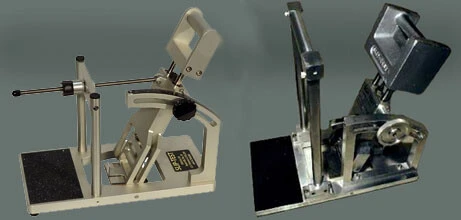
As you can see from the photo above, there appears to be very little difference between the Brungraber Mark II and the Brungraber Mark IIIB. The Mark IIB is a different color, but it appears to testing the floor in the same way as the Mark II. One added feature to the Mark IIIB is grooves cut into the rubber which is something car tire manufacturers do to give car tires more friction in the rain. So we can assume that the Mark IIIB, with it’s new and improved grooved rubber, will give the user higher readings that the Mark II did, which is fantastic for insurance company lawyers!
Any claim that the Brungraber Mark IIIB measures anything other than static coefficient of friction is interpretive marketing, not mechanics.
Mechanically, the device:
- Places a slider on the surface
- Applies a known normal force
- Increases tangential force by changing angle / load
- Detects the instant motion begins
- Reports μₛ = Fₜ / Fₙ at incipient slip
That is the definition of static coefficient of friction. So from a physics standpoint: It is impossible for the Mark IIIB to directly measure dynamic friction, gait friction, transitional friction, or walking friction.
It simply does not have the variables.
So why do people say it measures “more” than SCOF? Because of manufacturer aspiration, not measurement. Manufacturers want their devices to be relevant to walking, because:
Static COF sounds “old”
Dynamic COF sounds “modern”
Transitional just sounds bizarre and something juries won’t be capable of understanding because no device for floor slip resistance testing has ever measured transitional “COF”.
Courts and standards moved away from SCOF language when ASTM C1028 (SCOF test), ASTM F489 (for the James Machine’s SCOF test) ASTM F1677 (for the Brungraber Mark II’s SCOF test) and ASTM F1679 (for the English XL’s SCOF test) were all withdrawn because they measured the irrelevant SCOF, and was not helping stop slips in reality after years of being evaluated by OSHA, scientists in this field in Australia and the UK, and the ASTM.
So the language drifted from:
“Measures static coefficient of friction”
to:
“Measures friction relevant to walking”
to:
“Measures dynamic or transitional friction”
The Video Below Shows One Main Sources of the Slip and Fall Problem in America – Liars for Hire
Even though the Brungraber Mark II to the Brungraber Mark IIIB device never changed – other than a new paint job and grooves in the rubber slider to make it stick to slippery floors better for insurance company attorneys.
To say suddenly the Brungraber Mark IIIB measures anything other than SCOF is not science — that’s semantic inflation. The Brungraber Mark IIIB measures static coefficient of friction at the point of incipient slip. Any discussion of walking safety or slip potential based on these values represents interpretation beyond the direct measurement capability of the device.
Furthermore, a recent published study showed that the Mark IIIB, like its predecessor the Mark II lacked precision. It appears this may be why the users of this instrument, despite being the leaders of the ASTM F13 committee (whose job it is to publish pedestrian slip test standards, but haven’t published one for 30 years) for many years now, has not attempted to publish an ASTM test method for its use. An instrument must have precision and prove it to the ASTM to be considered a valid scientific device to have a published ASTM standard, like ASTM E303-22.
The manufacturer of the latest Brungraber, the Mark IIIB shown above, now states that this device is the first tribometer in the history of the world to measure transitional coefficient of friction. Seeing the tester performing its test, it sure looks like it’s measuring SCOF. It quacks like a duck and swims like a duck.
Here’s how to get the user of the Brungraber Mark IIIB thrown out of court.
The pendulum used in ASTM E303-22 has a peer-reviewed, published test method in over 50 nations, has been in use for about 75 years now, and is the most reliable and well-researched floor slip safety device on earth. Hands down. Want someone to confuse a jury because he’s done it a thousand times with his SCOF machine that is accepted by no one outside American courtrooms?
The Brungraber Mark IIIB measures one thing, and one thing only: static coefficient of friction. It measures the resistance at the exact instant a surface first begins to move. That is its design. That is its physics.
It does not measure walking. It does not measure heel strike. It does not measure motion, speed, momentum, balance, or human gait. It has no way to do so. There is no time component, no velocity component, and no simulation of a human step. Those variables simply do not exist in the measurement.
When someone tells you that this device measures “dynamic friction,” or “transitional friction,” or that it predicts how a person will walk across a floor, that is not a scientific conclusion — it is an interpretation layered on top of a static measurement.
And interpretation is not the same as measurement.
Science requires us to be precise about that distinction, especially in a courtroom. A device cannot magically measure something it was never designed to measure. Calling a static measurement by a more impressive name does not change the underlying physics.
That is why modern standards, including ASTM guidance, repeatedly caution against using any single friction number as a declaration of safety. They do not say that a number (such as 0.50) makes a floor safe. They do not say that a number prevents falls. And they certainly do not say that static friction equals walking safety.
So the real question for you is not whether a number was produced — it was. The question is whether that number was presented honestly, within the limits of what the instrument can actually measure.
If a conclusion goes beyond the measurement, then it is no longer science. It is storytelling.
Physics matters more than storytelling.